I recently taught a Sunday School lesson about the Good Samaritan story told by Jesus in Luke 10:25-37. Without addressing the whole thing here I just want to mention one of the points from that lesson. We need to be willing to acknowledge our biases and check them out. One assumption from the Samaritan story is that the Samaritan was an unlikely hero because Samaritans, in first century culture, were frowned upon and not well thought of in the Jewish community. This is bias and Jesus addressed that in the story.
Now, recently I had a friend visit the Ark Encounter and Creation Museum in the Cincinnati area and had a few questions for me about some of the exhibits they viewed. First, I’ll say that I have a bias regarding this museum. I have not visited it and I have a predisposition toward it in which I presume I won’t agree with a lot of their assertions. The reason for this is that I have some fundamental differences with the parent organization Answers in Genesis.
For those who know me, you may or may not be surprised at my position of disagreement with this organization. I may do a series of posts about that later, but let me just say that I disagree on some points, but I am in agreement with them in other areas. My differences lie in the way they present science and biblical interpretation. I am in agreement with them on fundamental doctrines of salvation, the inerrancy of Scripture, and the necessity and sufficiency of Jesus’ life, death and resurrection.
Now, specific to the questions posed to me about my friends’ visit, they centered around 5 interpretive panels they encountered, so I am only going to address those panels in this article.
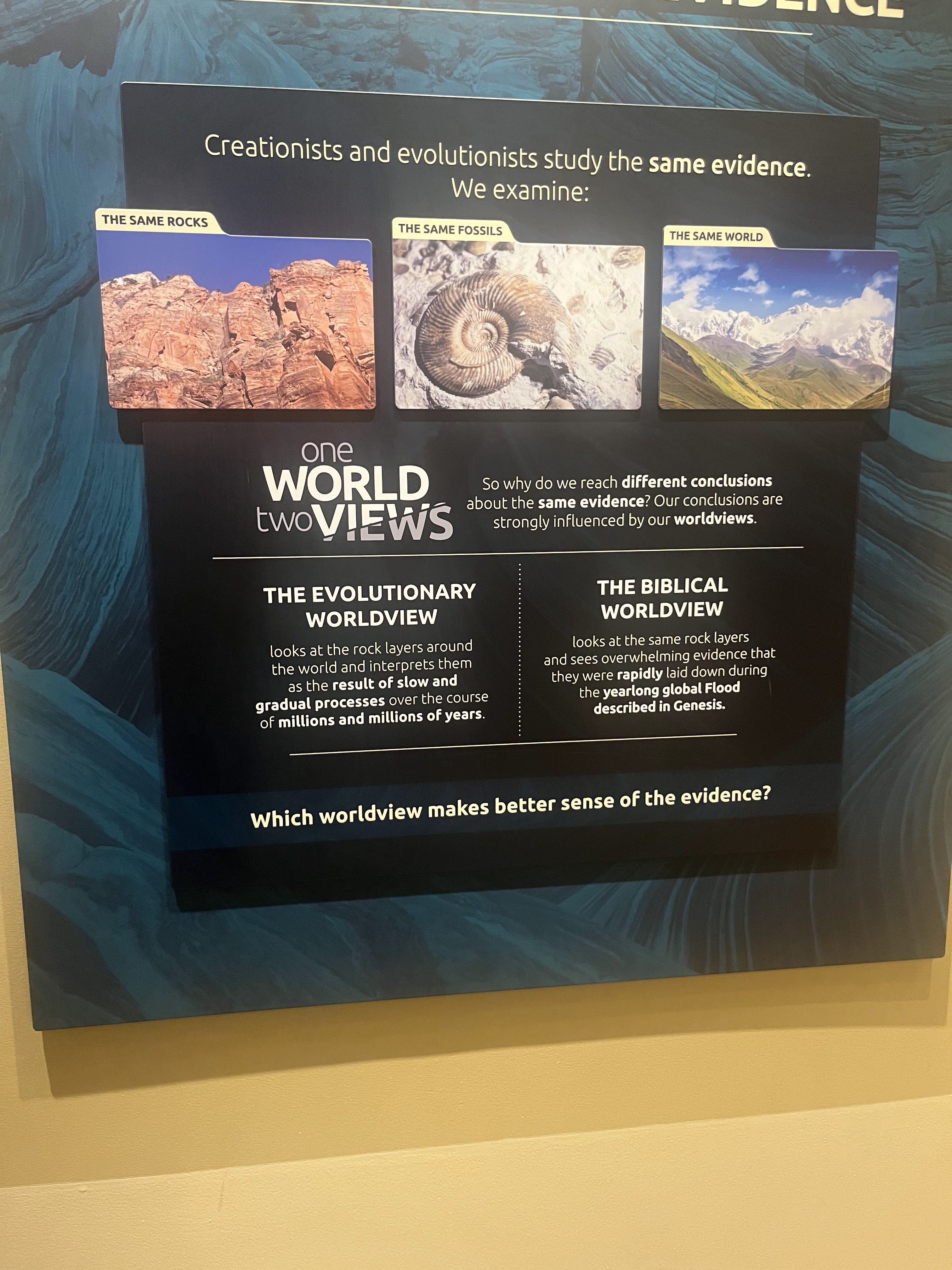
I am in full agreement with the premise that your worldview determines how you interpret the way the world works. But the implication of this particular panel is that there are only two possible worldviews. Now, admittedly, as a Christian (e.g. Christ follower) a part of my worldview stems from Jesus’ own statement about himself (John 14:6) – “I am the way and the truth and the life. No one comes to the Father except through me.” This is a truly dichotomous statement. Either you follow Jesus and enter heaven (God’s presence) or you don’t.
It would be nice if everything in Christendom were that clear and dichotomous. But it’s not. Ask many people if they are Christians, and they will reply “yes”, but when you drill deep into their actual beliefs you’ll find there are many differences. Some differences are bigger (e.g. more important) than others, but they exist nevertheless.
So, regarding the panel shown above I take issue with BOTH statements about worldview.
Evolutionary – “looks at the rock layers around the world and interprets them as the result of slow and gradual processes over the course of millions and millions of years.” This is an oversimplification of how “science” describes Earth history. Yes, it happened over the course of millions of years (actually 4.6 billion). But the implication here is that all processes of rock and fossil formation occur slowly and use all the time available to them. This is not how stratigraphy (the study of rock layering) describes it. In general (an oversimplification as well) rock layers form through generally quick processes of deposition (from water, wind, gravity, volcanic activity, dissolution, etc.) separated by periods of quiet. It’s not a continual, million-year process. And, there are many processes which contribute to a particular deposition. Every rock layer contains clues as to how it was formed, and they all have their own unique depositional characteristics.
Biblical – “looks at the same rock layers and sees overwhelming evidence that they were rapidly laid down during the yearlong global Flood described in Genesis.” This is also an oversimplification. First is the inherent bias in the assumption that only one biblical interpretation exists. Admittedly, one must be careful in just claiming that the Bible can mean multiple things to multiple people. It definitely has an original meaning that relates to the context, audience, and circumstances surrounding the writing of the text. I’m not going to elaborate here, but there is a biblical interpretation regarding the flood of Noah’s day that says that it was locally contained to the Mesopotamian region where all the people lived. The flood was meant to destroy all the inhabitants of the Earth (the people and animals in contact with them), but that does not require a global flood. For example, if people hadn’t spread yet to Australia, was it necessary to flood it to destroy life there?
These two statements are framed under the biased view that the Bible does not allow for any length of time in Earth history beyond about 6,000 to 10,000 years. It also operates under the biased view that only one interpretation exists for the Bible, and only one interpretation exists for “evolutionary science” (which, for the record, I consider myself an old-Earth Creationist, not an Evolutionary scientist. More on that in other posts.
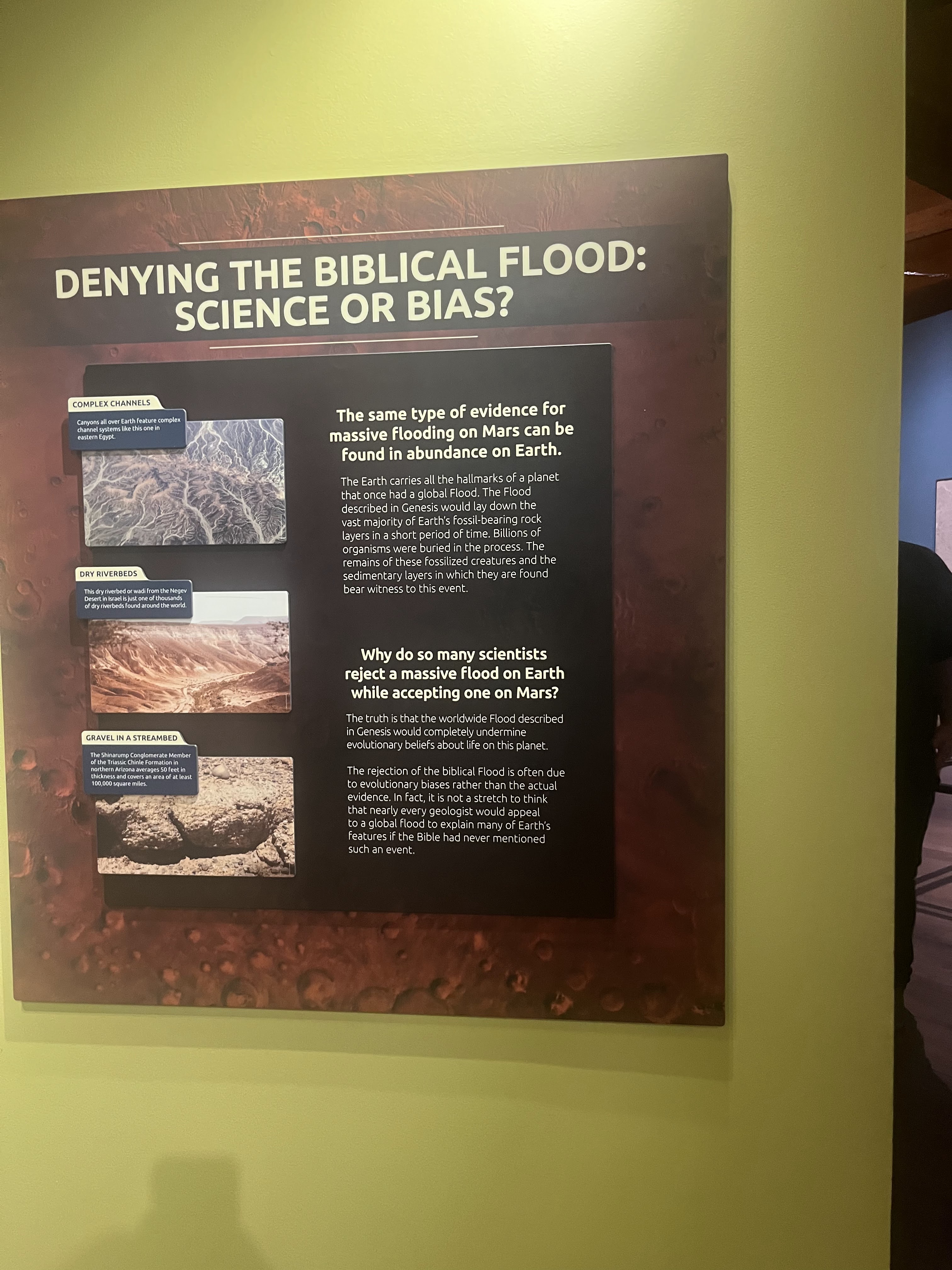
This panel addresses my assertion that Noah’s flood was not global. It does so first by mentioning flooding on Mars, but then never ties any of its illustrations to what that has to do with Mars in the first place. Regardless of that, the statement that “nearly every geologist would appeal to a global flood to explain many of Earth’s features if the Bible had never mentioned such an event.” This is a partially true statement. Geology (the study of rock formation and Earth history) is a relatively young science (250 years or so). In its early stages, there was a lot of interpretation of rock formation that tied them to Noah’s flood because it made sense. However, the picture that developed through further study and discoveries showed that individual rock layers were formed due to local events and processes, albeit many local flooding events. But floods are not the only way to form large, thick rock layers. Volcanic processes do. Dissolution of minerals from groundwater do. Desert wind storms do. Rockslides, earthquakes, and oceanic slides do as well. And again, many of these processes happen frequently and quickly, but scattered across multiple periods of time.
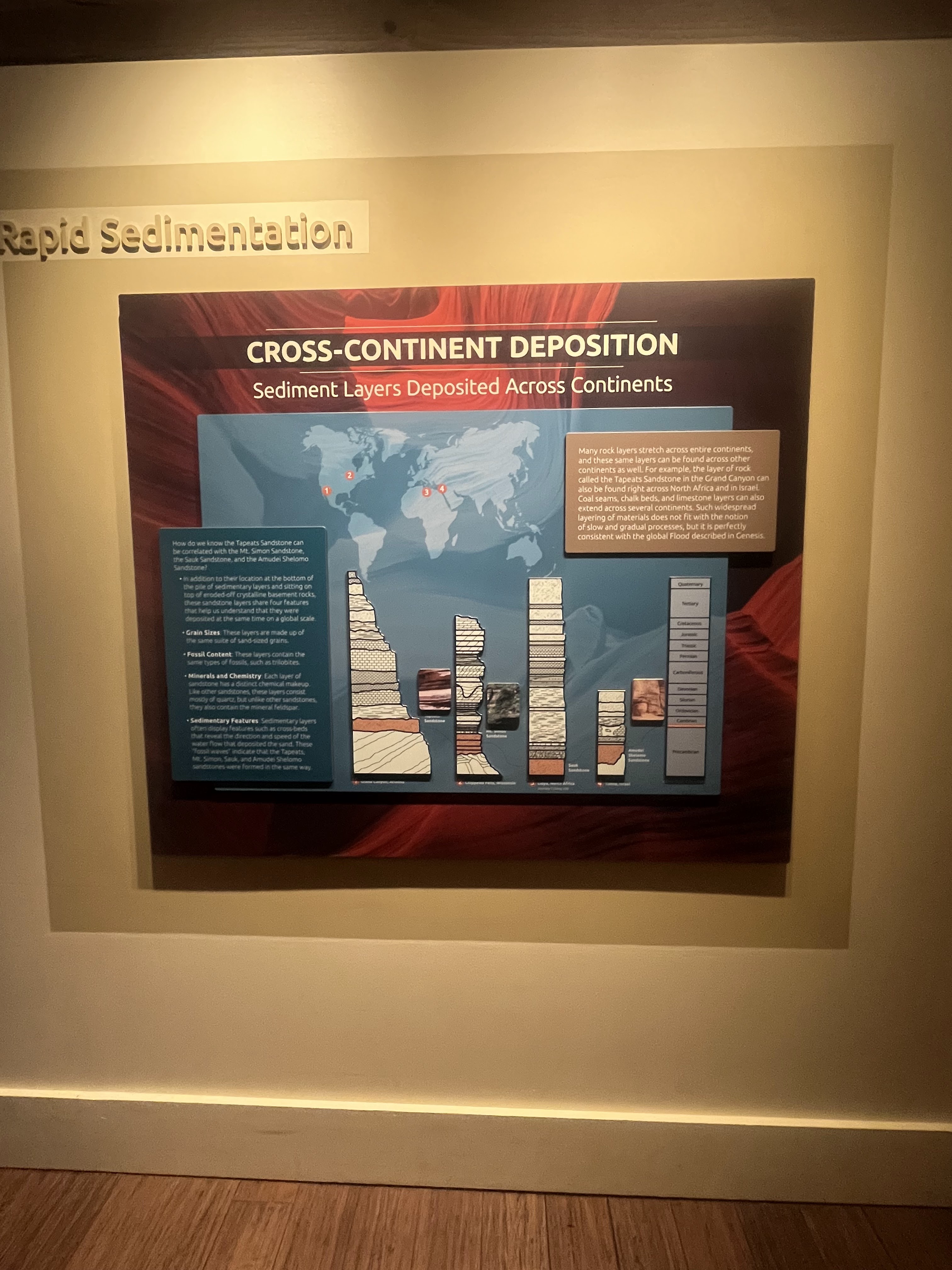
It is one thing to say that four rock layers scattered across the world are the same, and quite another to identify that they are similar. This panel is accurate in asserting that these rock formations all sit atop crystalline basement rock, lie beneath myriads of other layers, and have similar lithologies (e.g. sandstone). Geologists don’t deny a global flood altogether. The discrepancy comes in the dating/timing of the rock formations. Delve a little into Earth’s geologic history and you’ll find a consistent analysis that says that the early Earth, after cooling form its initial formation, was covered by a thick atmosphere and a worldwide ocean. This is before continents rose above the ocean surface. And, the continents were initially all igneous (crystalline) rocks formed from the cooling of magma. The continents rose as tectonic processes lifted them. This has occurred throughout Earth history and continues today. Erosion also occurs, and there is a time represented in the early continental formation when the continents were lifted up and then worn down, creating the surface overlain by these four rock layers (and others).
This is not that different than the image of the formation of the Earth painted in Genesis 1. I won’t delve into that here, but I will say that this global flooding and such is not the same as Noah’s flood. These events were well before the onset of multicellular life, but they do precede by a geologically short period of time the Cambrian Explosion of many different forms of multicellular life.
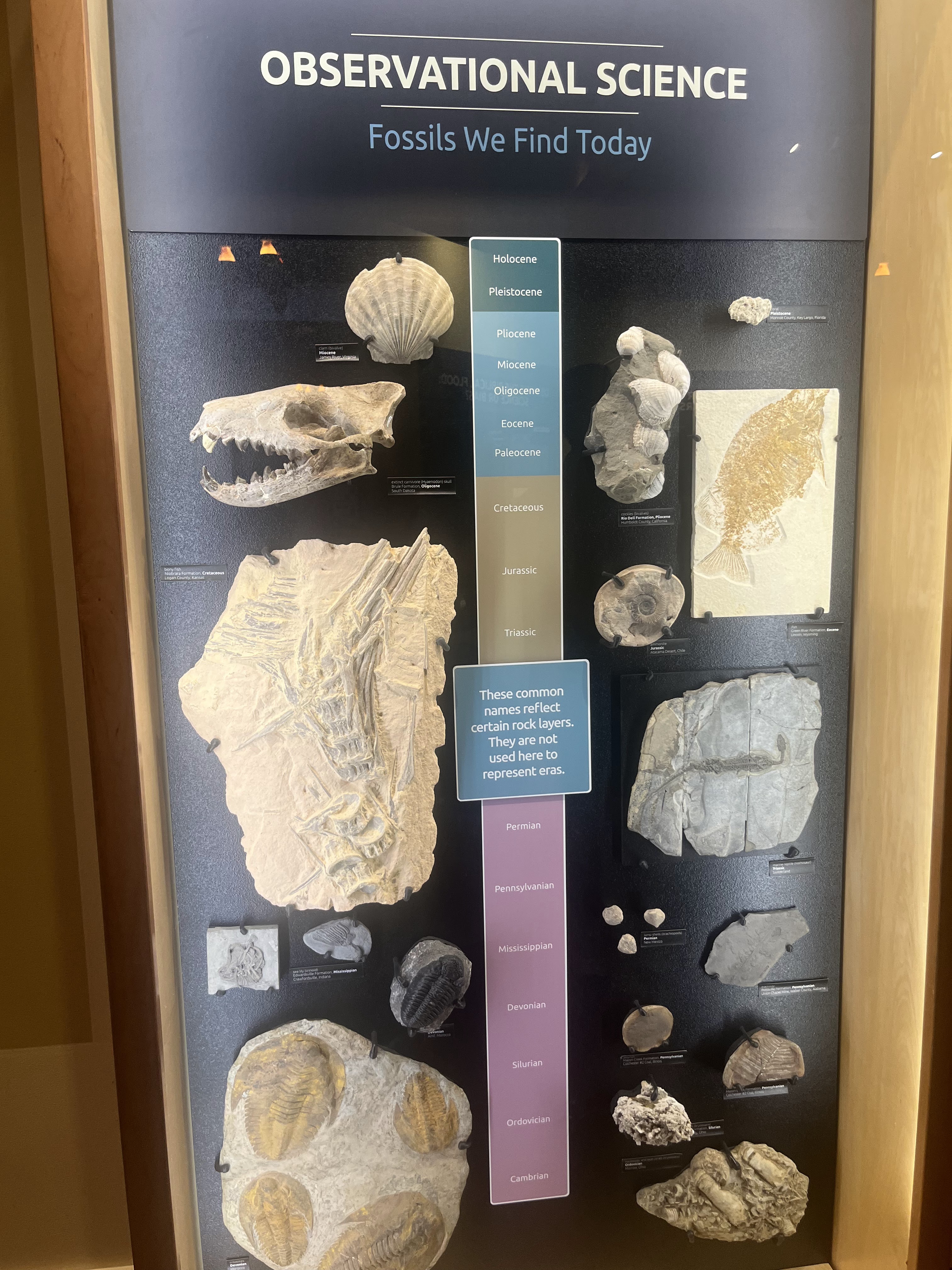
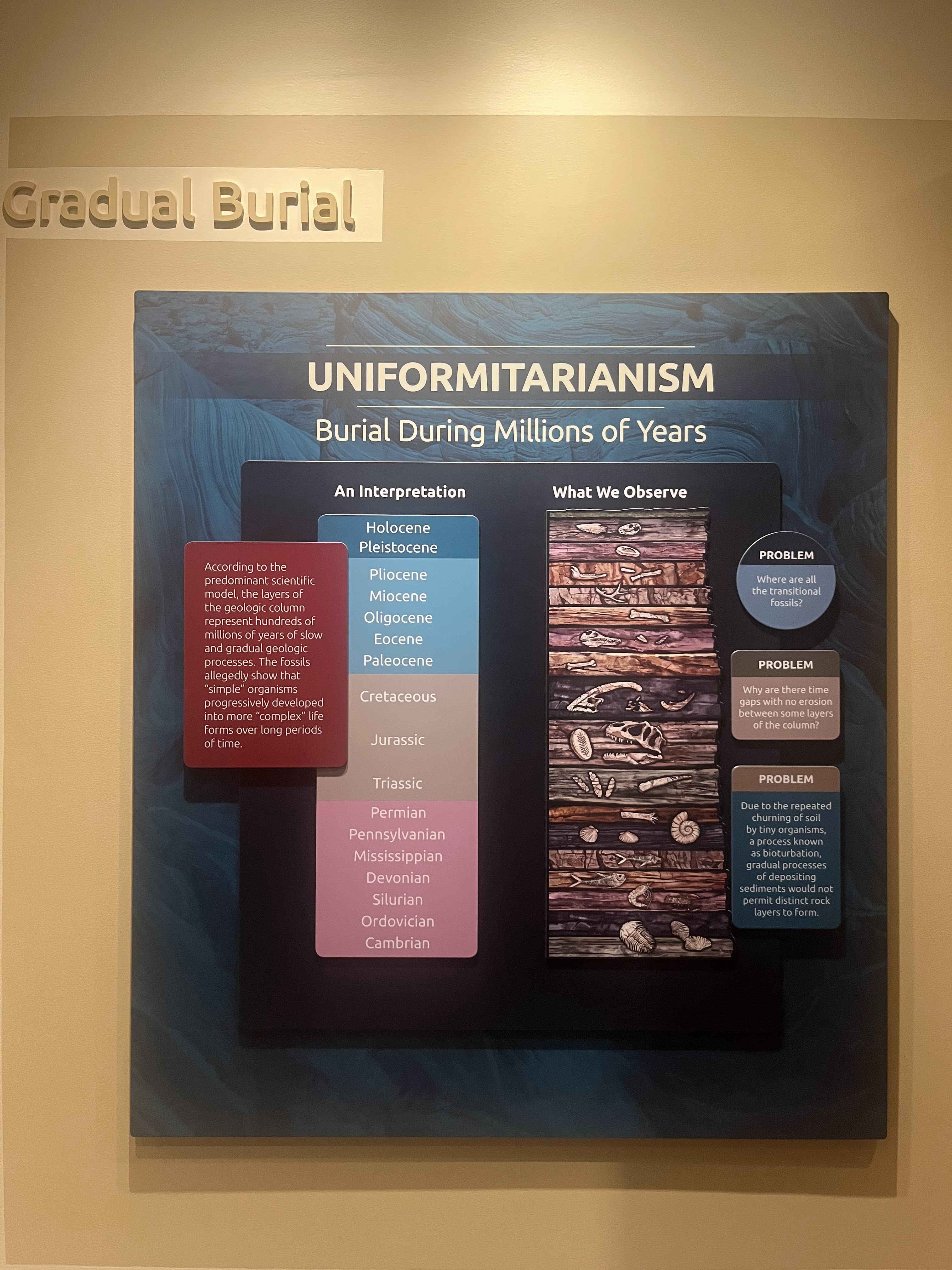
These two panels present a fairly accurate picture of the fossil and stratigraphic records. Again, though, the emphasis is on the biased assumption that the long periods of time represented continuous, slow processes rather than quick, catastrophic ones separated by times of quiescence. The “problems” identified are stated in a manner implying that these are unanswered questions, when they are questions the scientific community regularly ask and grapple with.
This brings us full circle back to my opening statement – we need to be willing to acknowledge our biases and check them out. Every person on Earth, for all time, has harbored bias or preconceptions about things based on their own belief system, or worldview. We must be willing to acknowledge that and try to assess our own bias and how it drives our view of things. I don’t begrudge the Answers in Genesis folks for their interpretations because I understand that they are holding to a particular worldview that is similar in some ways, but different in some ways, to my own. This is where we can hopefully meet in commonality of thought and debate/discuss our differences and assess how these differences relate to our worldviews. Ultimately, we trust in God.
Paul encourages the church in Philippi with these words (Philippians 3:12-16). “12 Not that I have already obtained all this, or have already arrived at my goal, but I press on to take hold of that for which Christ Jesus took hold of me. 13 Brothers and sisters, I do not consider myself yet to have taken hold of it. But one thing I do: Forgetting what is behind and straining toward what is ahead, 14 I press on toward the goal to win the prize for which God has called me heavenward in Christ Jesus. 15 All of us, then, who are mature should take such a view of things. And if on some point you think differently, that too God will make clear to you. 16 Only let us live up to what we have already attained.” As Christians, we should work together to share the gospel of Christ, and areas where we differ, we should trust God to work in us to bring us into agreement while always pressing onward in our work has His ambassadors!


One thought on “Acknowledging Bias”