A couple of weeks ago I wrote a post about the dual revelations of God – through His special (specific) revelation of His word and His Son, and through His general revelation revealed by what He has done.
I would like to explore some of the evidences for the Creator and how they may match up with scripture. In other words, dual revelation. For this post, I’m going to begin with the opening words of the Bible – “In the beginning, God created the heavens and the earth.” (Genesis 1:1)
The special revelation of Scripture says that there was a beginning. God was there first before the heavens and the earth and He created them. This perfectly matches what the universe says about its own origin (general revelation). Without belaboring the point, the four primary evidences to support the Big Bang origin of the universe are:
- Red-shift of the galaxies – As objects move away from us their light waves get “stretched out”, making them appear redder in color than they should. We can tell that waves are stretched because of the peculiar fingerprints of various elements that are embedded in the light waves. All the galaxies in the universe are red-shifted, indicating they are moving away from each other. This is what would be expected in an singular explosive event.
- Background radiation – The universe is filled with a uniform residual level of “radiation glow” consistent with a singular origin and cooling of that radiation.
- Age of the stars – As you look at more distant stars, their light has been traveling for longer periods of time. Light has a known fixed speed of ~186,000 miles per second. The farthest objects are a little over 13 billion light years (the distance light travels in a year) away, and the universe is thought to be only a little older than that.
- The ratio of the elements – All elements can be explained from nuclear processes occurring in stars of various ages. Stars of long ago (e.g. stars seen farthest from us and therefore oldest in age) are composed of the lighter elements present in the beginning (which was initially just hydrogen). The newer, closer stars are composed of the heavier elements created in the nuclear furnaces of the older stars.
Some might argue that the Big Bang does not require the existence of God. Carl Sagan, the famous astronomer, wrote in his Book Cosmos in the 1980s, “In many cultures it is customary to answer that God created the universe out of nothing. But this is mere temporizing. If we wish courageously to pursue the question, we must, of course ask next where God comes from? And if we decide this to be unanswerable, why not save a step and conclude that the universe has always existed.” This brings up an important aspect of the concept of Dual Revelation. What you do with the evidence is intimately tied with your own worldview. Some might call that another word for bias. However you want to describe it, your conception of how to interpret data such as this relies on your own deeply held beliefs.
I researched this concept extensively during my Master’s and Doctoral work. If you’re interested, you can download my Master’s thesis from the Colorado School of Mines library page and my Doctoral Dissertation can be found at the Auraria Library associated with the University of Colorado Denver.
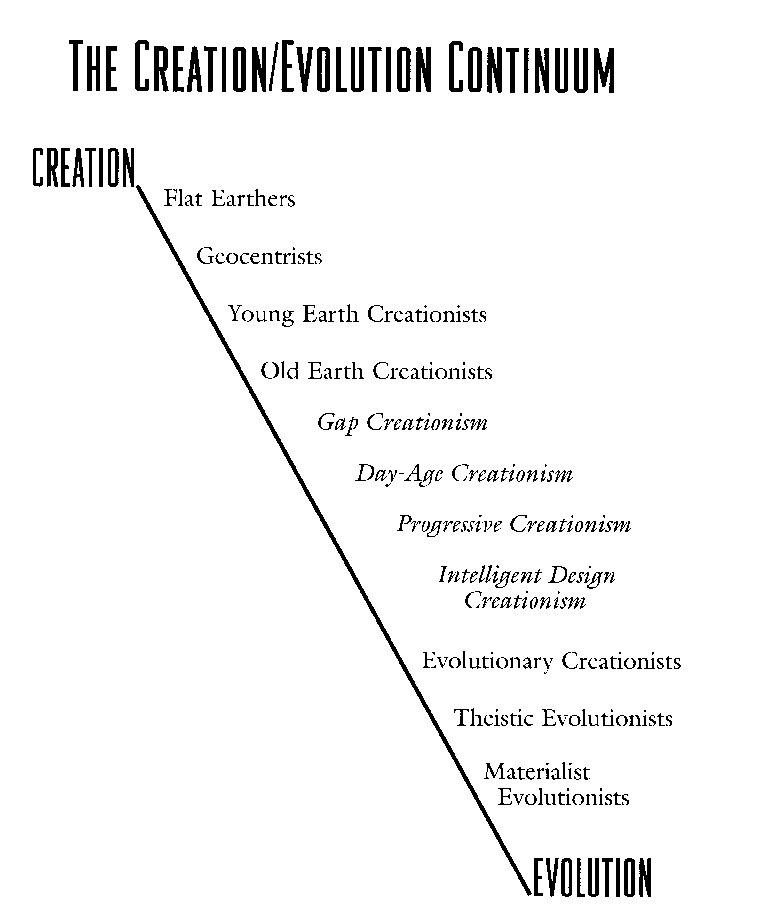
In my Master’s thesis I discussed a continuum (shown below) proposed by Eugenie Scott in her writings. She has a long career of research and opposition to the mixing of science and theology. I think this continuum, though, is a good illustration of the gamut of thinking about science and theology. It in essence could be identified as a worldview continuum linked to how much authority you give to God and science in your interpretation of them.
One of the emphases of both of my academic works cited above is the importance for everyone delving into these topics to examine and acknowledge both their own worldview (bias) and the implied worldview (bias) of those they are reading or responding to. It is only when we seek to understand why we believe what we do and why others believe what they do that we can engage in meaningful conversation about these issues.
If you’ve been reading my blogs for any length of time, or if you know me, hopefully my own worldview is obvious. But for the purpose of this particular article, let me be clear about it. “In the beginning, God created the heavens and the earth.” How I interpret this statement is tied to my own worldview. On the continuum illustrated above, I place myself on the line next to Progressive Creationism or Intelligent Design Creationism. Yes, I use the term “Creationist” to describe my own views because I believe in the Special Revelation of the “beginning” statement above. I have studied and sought to understand the other viewpoints of the continuum, but this is where I place myself.
I have friends who lie all along this continuum (except possibly the flat-earth and geocentrist extremes). I try to understand why they believe as they do and am always willing to engage in discussions with them. The readers of this blog also lie somewhere along the continuum and I respect that. But just to be clear, I have stated my position and it is from this worldview outlook that I write.
By the way, there is another “In the beginning” special revelation in Scripture. The first chapter of the gospel of John starts (1:1-3), “In the beginning was the Word, and the Word was with God, and the Word was God. He was in the beginning with God. All things were made through him, and without him was not any thing made that was made.” This is, of course, referring to the presence in the beginning of Jesus.
In coming “non-Life of Paul” weeks, I’ll delve more into Dual Revelation and how I see the general and special revelations of God fitting together.
 The Watchmaker's Pulse
Fascinating. Thank you.
LikeLike