It’s been two months since my last Life of Paul post. When we left off, Paul was in Corinth and had written his letter to the church in Rome (Romans) explaining major theological points and indicating his plans to travel there on his way to Spain.
Paul was in Corinth, as you’ll recall, on his third visit. His first was the 18 months spent there during his second missionary journey. His second visit was a confrontational one (not specifically recorded by Luke, but alluded to in Paul’s 2nd letter to the Corinthians). Paul had been in Ephesus ministering, interrupted his work to cross the Aegean Sea to confront the Corinthians about their behavior, returned to Ephesus and then proceeded to Troas and then northern Macedonia awaiting Titus’ return from delivering a letter which we don’t have. Then Paul received word through Titus that the Corinthians were willing to be reconciled with him and he traveled south to spend another three or so months there.
While there, he received from the church the financial gift they had prepared for the believers in Jerusalem and Paul (and company) are now preparing to leave Corinth and make their way to Jerusalem. Luke gives us the description of this next phase in Paul’s travels to complete his third missionary journey starting in Acts 20:3.
“There he spent three months, and when a plot was made against him by the Jews as he was about to set sail for Syria, he decided to return through Macedonia.”
Luke then lists the group of companions traveling from Corinth with Paul (vs. 4): “Sopater the Berean, son of Pyrrhus, accompanied him; and of the Thessalonians, Aristarchus and Secundus; and Gaius of Derbe, and Timothy; and the Asians, Tychicus and Trophimus.” As usual, Luke did not include himself in the list be indicates his presence in the next verses (vss. 5-6): “These went on ahead and were waiting for us at Troas, but we sailed away from Philippi after the days of Unleavened Bread, and in five days we came to them at Troas, where we stayed for seven days.“
This gives us a specific time period for when these travels occurred. Passover (the Feast of Unleavened Bread) is in the early spring. While in Troas, Luke tells us of an interesting event (vss. 7-12).
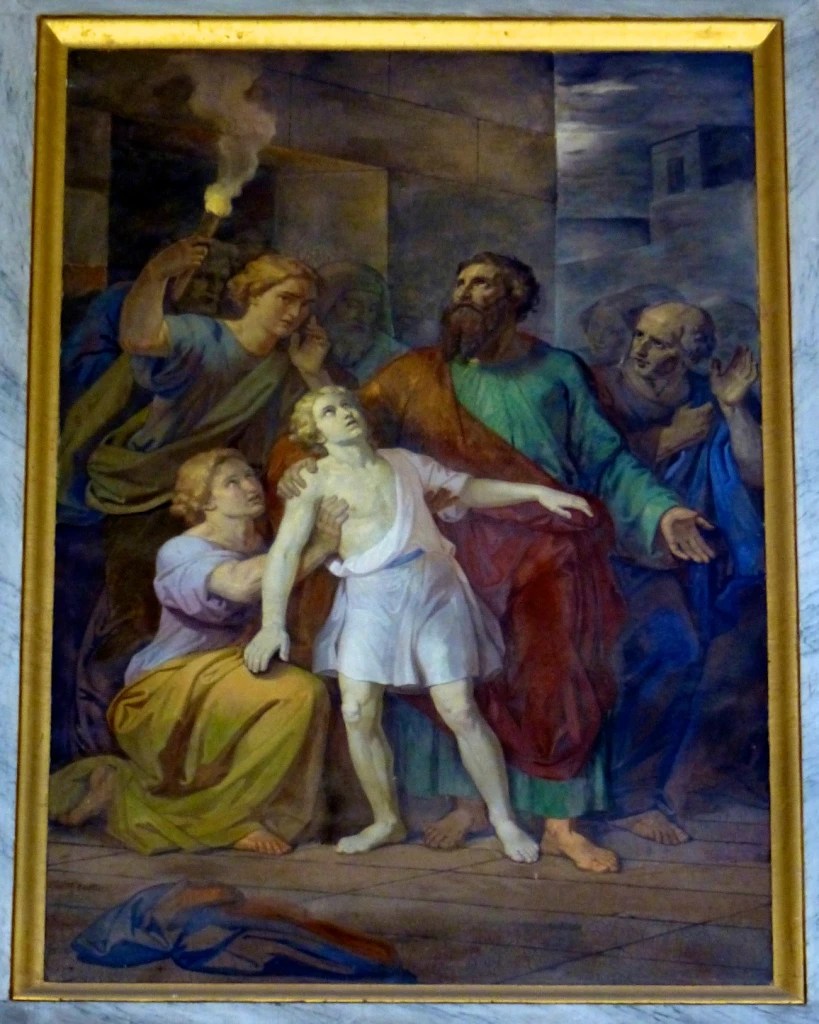
“On the first day of the week, when we were gathered together to break bread, Paul talked with them, intending to depart on the next day, and he prolonged his speech until midnight. There were many lamps in the upper room where we were gathered. And a young man named Eutychus, sitting at the window, sank into a deep sleep as Paul talked still longer. And being overcome by sleep, he fell down from the third story and was taken up dead. But Paul went down and bent over him, and taking him in his arms, said, “Do not be alarmed, for his life is in him.” And when Paul had gone up and had broken bread and eaten, he conversed with them a long while, until daybreak, and so departed. And they took the youth away alive, and were not a little comforted.“
The nineteenth fresco painting from the Papal Basilica of Saint Paul Outside the Walls (and photographed by the Hermit’s Door) depicts Paul raising Eutychus from the dead.
Luke continues describing the journey (vss. 13-16):
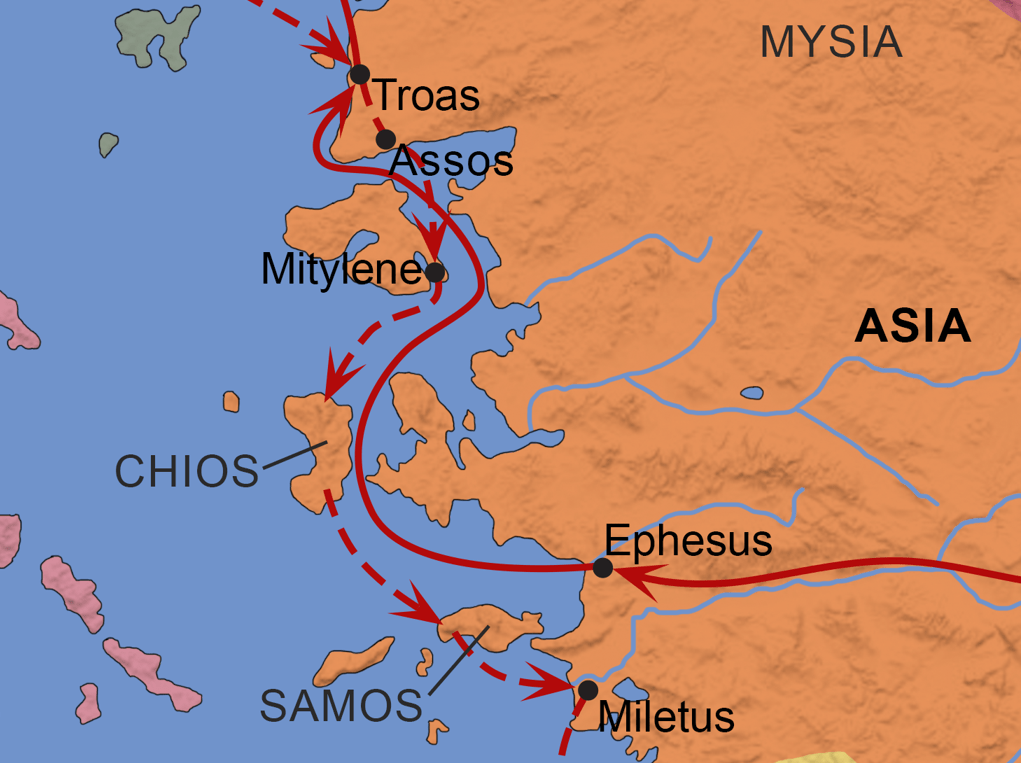
“But going ahead to the ship, we set sail for Assos, intending to take Paul aboard there, for so he had arranged, intending himself to go by land. And when he met us at Assos, we took him on board and went to Mitylene. And sailing from there we came the following day opposite Chios; the next day we touched at Samos; and the day after that we went to Miletus. For Paul had decided to sail past Ephesus, so that he might not have to spend time in Asia, for he was hastening to be at Jerusalem, if possible, on the day of Pentecost.“
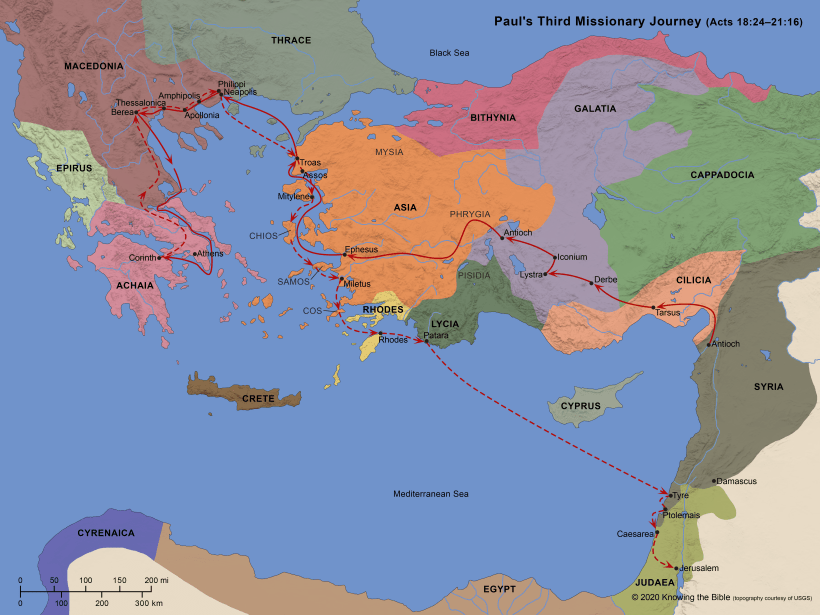
Luke indicates that Paul wanted to be in Jerusalem by Pentecost, which would be 50 days after leaving Philippi. The following map of his 3rd missionary journey shows the entire route, with the specific stops described above in the magnified image below that.
The fact that Paul wanted to travel some on foot (Troas to Assos) says to me that even though he was hurrying to Jerusalem, he was still on mission. Even though he had just spent three years in Ephesus, he still focused on areas which perhaps he had not trodden in order to continue spreading the gospel.
I know this is short, but let’s continue the story in the next post.
 The Watchmaker's Pulse