This is a continuation of my discussion of the book Why the Universe is the Way It Is by Hugh Ross of Reasons to Believe. The questions dealt with in the book are:
- Why such a vast universe? – This was the topic of the first post.
- Why such an old universe? – the topic of the second post.
- Why such a lonely universe? – the topic of the third post.
- Why such a dark universe? – the topic of this post.
- Why a decaying universe?
- Why a realm beyond this one?
- Why this particular planet, star, galaxy and universe?
- Why believe the Bible?
- Why not a perfect universe?
- Why these physical laws and dimensions?
- Why two creations?
- Why is the new creation better?
Have you ever heard of light pollution? It refers to areas that have so much artificial light that it impedes the ability to see the night sky. This can not only affect stargazers, but it can disrupt the natural light-cycles of living things as well. According to DarkSky.Org (from which the following map was copied) 80% of the world’s population lives under “skyglow.”
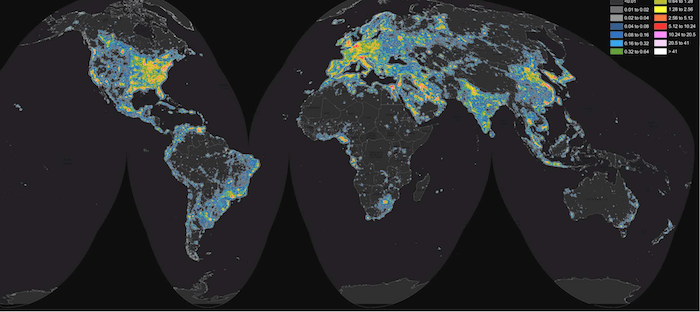
One of the points in the Universe book that I’m talking about in these posts is that we live in a time and place (in the universe/galaxy/solar system/era of time) in which we are fortunate enough to be able to learn and recognize how fortunate we actually are to live when and where we do! This is true of our placement in the Universe for being able to see the Universe. The Universe itself actually experiences light pollution in that there are places that are so crowded with luminous objects that it would be impossible to see the rest of the Universe from those places. That’s what this particular chapter is about.
The Moon
There was a book published in 1993 called What if the Moon Didn’t Exist? The author discussed all the things that would be different on Earth if the Moon were different than it is. Hugh Ross elaborates on some of those details.
While the Moon is bright enough to impact successful viewing of the night sky, it does go through phases that give us periods of darker darkness in which we can observe the Universe. We need the Moon, though, to be exactly the size and place that it is to:
- Stabilize Earth’s rotational axis angle, which stabilizes our seasons and climate
- Stabilize our rotation speed. Earth has slowed it’s rotation over the eons due to the Moon’s gravitational drag effect. We currently live with a 24-hour day, which is optimal for day/night temperature fluctuation stability. Longer or shorter and things would not be comfortable for human life.
- Stabilize our tides, which help maintain healthy nutrient and toxin levels near shorelines.
The Moon also has a dark surface due to its chemical composition (which isn’t cheese!). It has a 7% reflectivity, as compared to Earth’s 39%. That at least helps it to not be so overwhelmingly bright at night!
Dark Planetary Companions
Other than the Sun and Moon, the next brightest objects in our sky are our planetary neighbors in the solar system. However, our distance from them and their relative placement in the solar system prevents them from blocking too much of our view. And, they fulfill life-essential roles because of their placement. The large outer planet provide a nice safety net by gravitationally sweeping much of the large debris (asteroids, comets, etc.) from collision paths with us. However, these large planets could cause orbital instability or eccentricity in Earth’s orbit if it were not for the stabilizing role of the closer but smaller inner planets. We are positioned at just the right spot to maintain a living habitat!
Distant Star Clusters
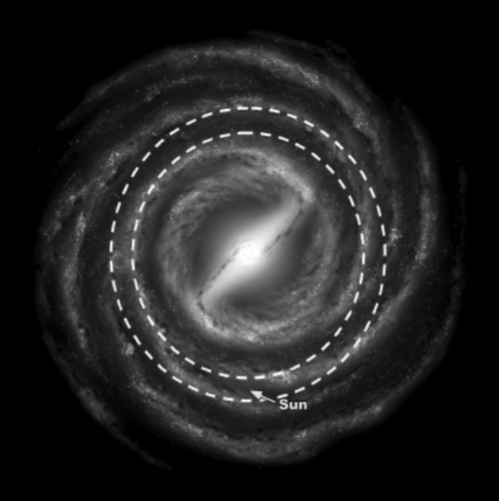
In the representative diagram below (obviously it’s not our galaxy, but where we would be if we could look down on it from above) our solar system is located in between two spiral arms. We are also in the actual plane (disc) of the Milky Way galaxy. This position means that we are sheltered from extreme sources of light (and radiation) by the dust clouds within the plane, and we are distant from the bright clusters of stars that make up the denser regions of the galaxy. The dashed circular band in the diagram represents where in the galaxy a planet would need to be to be habitable. Even though we are shielded from the brightest part of our galaxy by dust clouds, they don’t significantly impede our view of most of the rest of the Universe.
Dark Nebulae
We happen to be fortunate that the Milky Way galaxy does not contain gigantic star-forming nebulae, which tend to be very bright. The few star-forming gas clouds we do have in our galaxy are not very close to us and so do not impede our view much. We can see these giant star formation clouds in other galaxies and if we had such big ones as close to us as the smaller ones in our galaxy they could be as bright as 80 Moons in our night sky!
Dark Galaxy Clusters
Most galaxies in the Universe occur in groups, or clusters, which pack them quite close together. Our Milky Way is indeed in a Local Group Cluster of galaxies. However, our cluster is dispersed more than many others that we can see. If ours were more typical instead of uniquely spacious, our night vision would be drastically reduced by bright galaxies in the sky.
The main point of all this is that we are placed in a position that is not only conducive to allowing life to proliferate, but it allows us to learn that we are in a special place. God wanted us to be able to marvel at the care and planning that He did to provide us a nice place to live!
 The Watchmaker's Pulse
3 thoughts on “A Universe Just for Us (Part 4)”