In the last Life of Paul post we saw Paul arrive in Ephesus during his third missionary journey. When we left him, Luke had just told us that he had completed two years of ministry in the region (Acts 19:10) – “This continued for two years, so that all the residents of Asia heard the word of the Lord, both Jews and Greeks.” Paul actually spent about three years there, but Luke was summarizing things up to this point, emphasizing the extent of Paul’s influence in the area. He then elaborates a little more in verses 11-20.
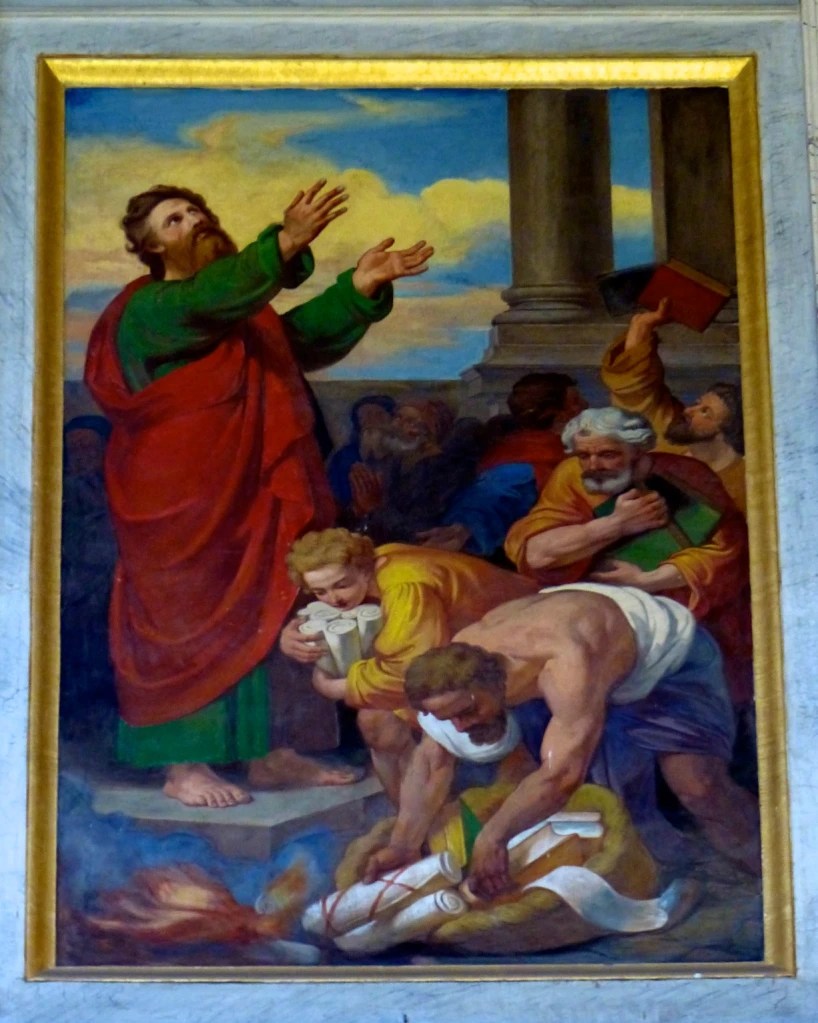
“And God was doing extraordinary miracles by the hands of Paul, so that even handkerchiefs or aprons that had touched his skin were carried away to the sick, and their diseases left them and the evil spirits came out of them. Then some of the itinerant Jewish exorcists undertook to invoke the name of the Lord Jesus over those who had evil spirits, saying, ‘I adjure you by the Jesus whom Paul proclaims.’ Seven sons of a Jewish high priest named Sceva were doing this. But the evil spirit answered them, ‘Jesus I know, and Paul I recognize, but who are you?’ And the man in whom was the evil spirit leaped on them, mastered all of them and overpowered them, so that they fled out of that house naked and wounded. And this became known to all the residents of Ephesus, both Jews and Greeks. And fear fell upon them all, and the name of the Lord Jesus was extolled. Also many of those who were now believers came, confessing and divulging their practices. And a number of those who had practiced magic arts brought their books together and burned them in the sight of all. And they counted the value of them and found it came to fifty thousand pieces of silver. So the word of the Lord continued to increase and prevail mightily.“
The eighteenth fresco painting from the Papal Basilica of Saint Paul Outside the Walls (and photographed by the Hermit’s Door) shows the people gathering the scrolls for burning as described above.
There was quite a spiritual awakening happening in Ephesus! While he was in Ephesus, a series of communications began between Paul and the Corinthian Christians. A good article summarizing these communications can be read at https://zondervanacademic.com/blog/four-letters-corinthians.
Paul sent a letter to believers in Corinth (which I’ll refer to as 0th Corinthians), in which he urged them to avoid immoral people (1 Cor. 5:9 – “I wrote to you in my letter not to associate with sexually immoral people”). This command is likely in response to the general wide-spread knowledge of the loose morals in Corinth, which Paul would have witnessed first-hand while ministering there. Although we know nothing else certain about this letter, it may have prompted some of the questions raised by a letter that Paul received from Corinth.
At some point Paul received visitors from Corinth, including Apollos, Chloe’s household, Stephanas, Fortunatus, and Achaicus. If you’ll remember, we read about Apollos going to Corinth in my last post (Acts 18:27-28). These visitors would tell Paul about various issues going on in the church there, and also deliver a letter to him from the church filled with questions.
While we don’t have a copy of either the first letter Paul wrote to the Corinthians nor the letter they wrote to him, their letter probably included the following elements:
- Quotes that Paul references in his reply
- Everything is permissible for me (1 Cor 6:12)
- Foods for the stomach and stomach for foods (1 Cor. 6:13)
- Every sin a person can commit is outside the body (1 Cor. 6:18)
- We all have knowledge (1 Cor. 8:1)
- An idol is nothing in the world (1 Cor. 8:4)
- There is no God but one (1 Cor. 8:4)
- There is no resurrection of the dead (1 Cor. 15:12)
- Questions asked by the church
- Is it good for a man not to have relations with a woman? (1 Cor. 7:1)
- What about the unmarried and widows – sex, yes or no? (1 Cor. 7:8)
- Should virgins marry? (1 Cor. 7:25)
- Is it acceptable to eat food sacrificed to idols? (1 Cor. 8:1)
- How does the Spirit of God manifest itself? (1 Cor. 12:1)
- When people die, will they ever really be resurrected? (1 Cor. 15:12)
- Should we be taking up offerings to help other believers? (1 Cor. 16:1)
- Would you ask Apollos to come back to us again? (1 Cor. 16:12)
- Paul’s teaching on head coverings must have been prompted by a report he received, but may also have been a subject in this letter. (1 Cor. 11:4-12)
- The Corinthians may have an ongoing dispute about whose spiritual gift is superior, which may be in the verbal reports or implied from the letter (1 Cor. 14:2-3)
Some things referenced in Paul’s response to the Corinthians (1 Corinthians) that give us insight into events in Ephesus and also the reports he received from the Corinthian visitors are:
- Paul refers to fighting wild animals in Ephesus. Whether these are real, or metaphorical, something happened to prompt this statement (1 Cor. 15:32)
- Paul mentions a “wide door of ministry” being opened, but still much opposition (1 Cor. 16:9) This could include Emperor Claudius’ death – which ended the Jewish banishment from Rome, and the writing and distribution of the gospel of Mark.
- Divisions/factions are developing in the church (1 Cor. 1:12)
- Attitudes of pride and self-righteousness prompt a sarcastic response from Paul (1 Cor. 4:8-10)
- There is rampant sexual immorality (1 Cor. 5:1)
- There are also lots of lawsuits happening (1 Cor. 6:1)
- They seem to be wanting to adopt the local custom of ritualistic prostitution as part of worship (1 Cor. 6:15-17)
- Some issue has arisen prompting Paul to feel the need to defend his and others’ rights as apostles (1 Cor. 9:1-12)
- There is profiteering in Corinth from “preaching” another gospel (1 Cor. 9:1-18)
- They are misusing and demeaning of the Lord’s Supper (1 Cor. 11: 17-22)
- Worship is characterized by disorder and noise (1 Cor. 14:26)
- There are apparently unruly women, prompting Paul’s comments in 1 Cor. 14:33-35
- They are baptizing people for the dead (1 Cor. 15:29)
- Paul’s research and references used for this letter includes Genesis (2), Exodus (32), Deuteronomy (17, 25), Isaiah (22, 25, 29, 52, 64), Job (5), Psalm (8, 24, 94), Hosea (13)
Next time we’ll begin to look more closely at the content of Paul’s 2nd letter to Corinth (1 Corinthians).
 The Watchmaker's Pulse
2 thoughts on “Life of Paul 25”