Just as a point of review, the website of Dwell Community Church has an interesting article that suggests some timings and dates for Paul’s ministry. According to it, Paul completed his second missionary journey in the fall of AD 51. He then set out on his third missionary journey in the spring of AD 52. Luke, the writer of Acts, describes this ending and new beginning in just two verses (Acts 18:22-23).
“When he had landed at Caesarea, he went up and greeted the church, and then went down to Antioch. After spending some time there, he departed and went from one place to the next through the region of Galatia and Phrygia, strengthening all the disciples.“
That single statement – “after spending some time there” represents the four to six months that Paul spent preparing to start out again. In the meantime, Luke takes a little time in his story (Acts 18:24-28 – even though it doesn’t directly talk about Paul’s actions) to tell us about events that took place in Ephesus and its surrounding region during that time between Paul’s two journeys. The events he describes become critical parts of Paul’s story and actions to come.
“Now a Jew named Apollos, a native of Alexandria, came to Ephesus. He was an eloquent man, competent in the Scriptures. He had been instructed in the way of the Lord. And being fervent in spirit, he spoke and taught accurately the things concerning Jesus, though he knew only the baptism of John. He began to speak boldly in the synagogue, but when Priscilla and Aquila heard him, they took him aside and explained to him the way of God more accurately. And when he wished to cross to Achaia, the brothers encouraged him and wrote to the disciples to welcome him. When he arrived, he greatly helped those who through grace had believed, for he powerfully refuted the Jews in public, showing by the Scriptures that the Christ was Jesus.“
Apollos is an intriguing character to me. He reminds me a little of Paul, before Paul became a Christian. He was zealous for the Lord and well educated in the Jewish scriptures (the Old Testament). Apollos was also a little like John the Baptist, following John’s teaching of repentance and of anticipation of the promised Messiah from God. He also knew of Jesus (possibly through some of the statements John had made about Jesus being the Lamb of God) but had not fully connected the dots of Jesus as fulfilling all the prophecies and requirements as God’s Messiah. Perhaps he had not heard of the outpouring of the Holy Spirit at Pentecost or of Jesus’ post-resurrection appearances and commission to his disciples to spread the gospel and build the church.
Apollos was preaching and teaching in the synagogue when Priscilla and Aquilla heard him. They invited him to spend time with them and they corrected or expanded his theological understanding of the gospel. Priscilla and Aquilla had been taught by Paul in Corinth and were well-versed in Pauline theology and they passed this knowledge on to Apollos. They then encouraged Apollos to cross the Aegean Sea and help further the education of the believers in Corinth.
I don’t know when Apollos became a Christian. I know that it is possible to believe in Christ with only a partial understanding. For example, I became a Christian when I was eight years old and understood the fundamentals of the necessity of Christ’s sacrifice on my behalf for the restitution of my sin, but I was only eight and did not have near the capacity nor understanding of the gospel that I have now. However, Jesus himself said (in Luke 18:17), “Truly, I say to you, whoever does not receive the kingdom of God like a child shall not enter it.” I think Apollos believed in Jesus already as the Messiah when Aquila and Priscilla heard him in the synagogue. Luke tells us that he was teaching “accurately” about Jesus.
Apollos would become a very important part of the Corinthian believers’ theological growth and a valued acquaintance of Paul later on.
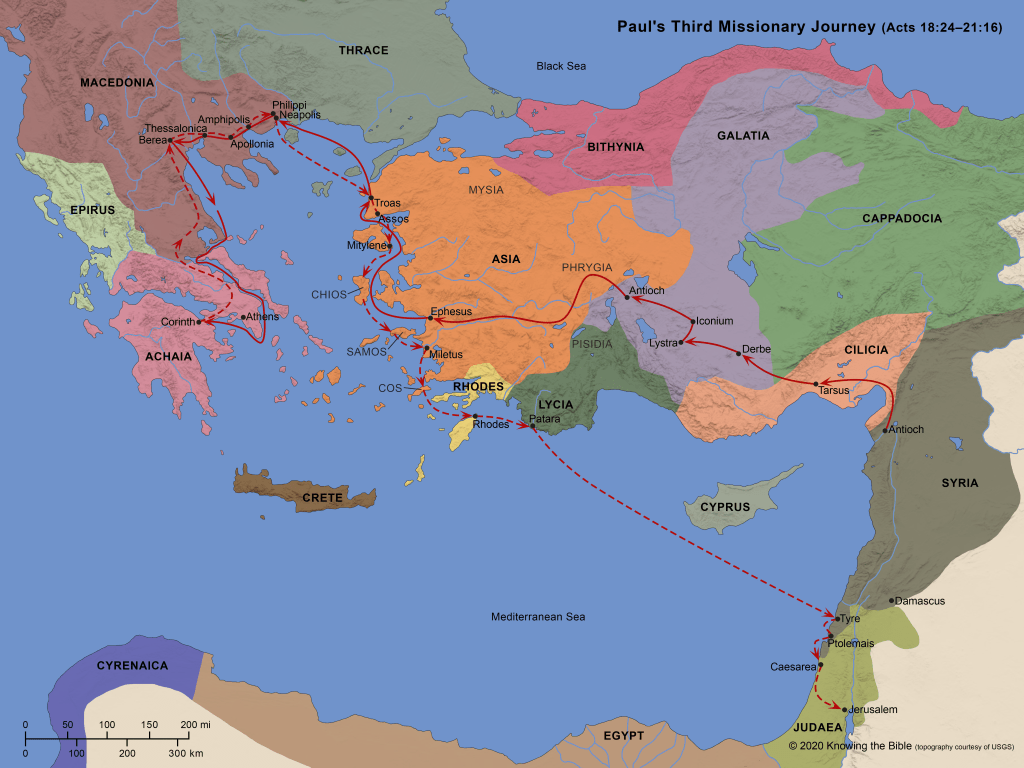
The map below (from Knowing the Bible.net) shows the route of Paul’s third missionary journey. As with the first two trips, he first went to Galatia and visited the churches that he and Barnabas had established there. He then took a more southerly route across Asia to the city of Ephesus.
I’ve referenced Dave Stotts’ Bible Backroads series before. He talks about the city of Ephesus in the first episode of the series about the book of Ephesians. We’ll look at the book of Ephesians later, but this would be a good time to watch the first episode to get a nice description of what the city of Ephesus was like.
Luke continues his description of Paul’s latest journey in Acts 19:1-10.
“And it happened that while Apollos was at Corinth, Paul passed through the inland country and came to Ephesus. There he found some disciples. And he said to them, “Did you receive the Holy Spirit when you believed?” And they said, “No, we have not even heard that there is a Holy Spirit.” And he said, “Into what then were you baptized?” They said, “Into John’s baptism.” And Paul said, “John baptized with the baptism of repentance, telling the people to believe in the one who was to come after him, that is, Jesus.” On hearing this, they were baptized in the name of the Lord Jesus. And when Paul had laid his hands on them, the Holy Spirit came on them, and they began speaking in tongues and prophesying. There were about twelve men in all.“
Here we have an instance of devout “disciples” who were “stuck” in John’s incomplete theology. This is a little different than Apollos’ story. Apollos knew of Jesus, and that he is the promised Messiah. These believers, though, had not made that connection yet. The fundamental difference is that they were still anticipating the coming Messiah rather than recognizing that he had already come and fulfilled God’s plan. Instead of still “looking”, Paul helped these disciples to recognize and believe in Jesus as the “already done it” one!
Luke continues the story by telling us how Paul settled into his time of ministry in Ephesus.
“And he entered the synagogue and for three months spoke boldly, reasoning and persuading them about the kingdom of God. But when some became stubborn and continued in unbelief, speaking evil of the Way before the congregation, he withdrew from them and took the disciples with him, reasoning daily in the hall of Tyrannus. This continued for two years, so that all the residents of Asia heard the word of the Lord, both Jews and Greeks.“
Next time we’ll begin looking at some of the details of Paul’s time in Ephesus and his communications across the sea with the church in Corinth.
 The Watchmaker's Pulse
One thought on “Life of Paul 24”