Paul finished his visit to Athens and proceeded on to Corinth. Luke tells us, in Acts 18:1-5,
“After this Paul left Athens and went to Corinth. And he found a Jew named Aquila, a native of Pontus, recently come from Italy with his wife Priscilla, because Claudius had commanded all the Jews to leave Rome. And he went to see them, and because he was of the same trade he stayed with them and worked, for they were tentmakers by trade. And he reasoned in the synagogue every Sabbath, and tried to persuade Jews and Greeks. When Silas and Timothy arrived from Macedonia, Paul was occupied with the word, testifying to the Jews that the Christ was Jesus.“
There are three elements in this paragraph that I want to refer back to later in this post:
- Claudius’ expulsion of the Jews from Rome – According to the Jewish virtual library, Claudius was Roman Emperor from 41 to 54 A.D. His banishment may not have been as so much a persecution but a peace-making effort because of clashes between Jews and Christians.
- Tent-making – Paul’s reason for seeking out Aquila and Priscilla was their occupation. I doubt that he knew them prior to this but rather found them through their shared vocation.
- Timothy and Silas – These companions of Paul’s had been left at Berea. It was Paul and Silas imprisoned in Philippi (no mention of Timothy). Paul and Silas then preached in Thessalonica and apparently Timothy stayed in Philippi a while, rejoining them in Berea. When Paul went on to Athens, he sent word back to Timothy and Silas to come join him as soon as possible. Luke, also a companion of Paul, in these accounts, never mentions himself.
The seventeenth fresco painting from the Papal Basilica of Saint Paul Outside the Walls (and photographed by the Hermit’s Door) depicts Paul worshipping with Aquila and Priscilla.
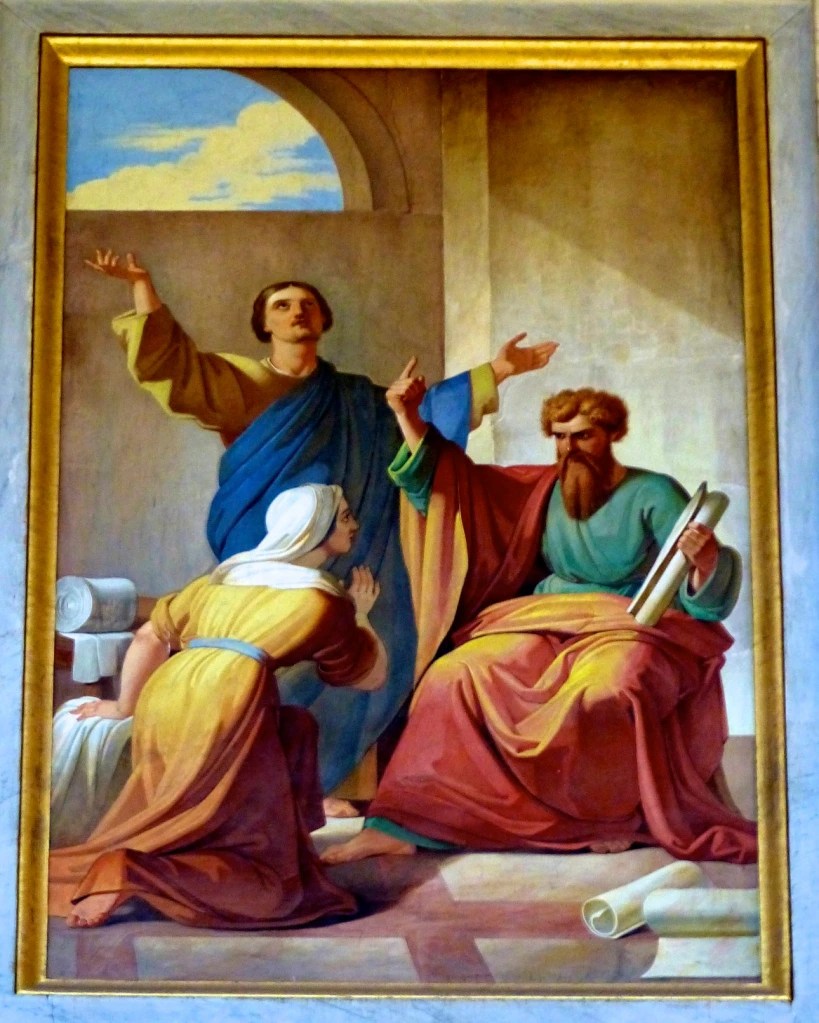
As Paul was joined in Corinth, Timothy and Silas brought him reports from and about the Christians in Thessalonica. It had only been a few months since the missionaries first arrived in Thessalonica. The news they brought, and the freshness of the memories of their work there, prompted Paul to compose his first letter to the Christians there.
Here are the first three chapters of Paul’s first letter to the Thessalonians.
“Paul, Silvanus, and Timothy, to the church of the Thessalonians in God the Father and the Lord Jesus Christ: Grace to you and peace.“
Paul identifies the collaborators as the three evangelists that the Thessalonians would remember. He then spends the next three chapters reminding the Thessalonians of their visit there and of the reports that Timothy and Silas brought to him.
“We give thanks to God always for all of you, constantly mentioning you in our prayers, remembering before our God and Father your work of faith and labor of love and steadfastness of hope in our Lord Jesus Christ. For we know, brothers loved by God, that he has chosen you, because our gospel came to you not only in word, but also in power and in the Holy Spirit and with full conviction. You know what kind of men we proved to be among you for your sake.“
Paul reminds the church about the conditions in which they came to faith – with initial joy but under the quick duress of persecution. They had heard already about Paul and Silas’ treatment in Philippi and Paul warned them that they would suffer likewise.
“And you became imitators of us and of the Lord, for you received the word in much affliction, with the joy of the Holy Spirit, so that you became an example to all the believers in Macedonia and in Achaia. For not only has the word of the Lord sounded forth from you in Macedonia and Achaia, but your faith in God has gone forth everywhere, so that we need not say anything. For they themselves report concerning us the kind of reception we had among you, and how you turned to God from idols to serve the living and true God, and to wait for his Son from heaven, whom he raised from the dead, Jesus who delivers us from the wrath to come.“
I find it fascinating that, while it’s been only a few months since Paul left Thessalonica, the word of their faith has spread all the way to Corinth (Achaia). This makes sense, though, in light of the expulsion of the Jews from Rome mentioned above. The Jews, as they traveled south away from Rome, would have heard about the conflicts arising between Jews and Christians in Thessalonica just as they had in Rome. These stories, then, would have been easily carried with the travelers as the continued their journey away from Rome.
“For you yourselves know, brothers, that our coming to you was not in vain. But though we had already suffered and been shamefully treated at Philippi, as you know, we had boldness in our God to declare to you the gospel of God in the midst of much conflict. For our appeal does not spring from error or impurity or any attempt to deceive, but just as we have been approved by God to be entrusted with the gospel, so we speak, not to please man, but to please God who tests our hearts. For we never came with words of flattery, as you know, nor with a pretext for greed—God is witness. Nor did we seek glory from people, whether from you or from others, though we could have made demands as apostles of Christ. But we were gentle among you, like a nursing mother taking care of her own children. So, being affectionately desirous of you, we were ready to share with you not only the gospel of God abut also our own selves, because you had become very dear to us.“
“For you remember, brothers, our labor and toil: we worked night and day, that we might not be a burden to any of you, while we proclaimed to you the gospel of God. You are witnesses, and God also, how holy and righteous and blameless was our conduct toward you believers. For you know how, like a father with his children, we exhorted each one of you and encouraged you and charged you to walk in a manner worthy of God, who calls you into his own kingdom and glory.“
Here we learn that Paul must have done in Thessalonica what he did upon arrival in Corinth. He sought out a place in the marketplace where he could put his tradesman (tentmaking) skills to use to earn money and thus set an example for the Thessalonians for how they should mix their faith with their life’s work.
“And we also thank God constantly for this, that when you received the word of God, which you heard from us, you accepted it not as the word of men but as what it really is, the word of God, which is at work in you believers. For you, brothers, became imitators of the churches of God in Christ Jesus that are in Judea. For you suffered the same things from your own countrymen as they did from the Jews, who killed both the Lord Jesus and the prophets, and drove us out, and displease God and oppose all mankind by hindering us from speaking to the Gentiles that they might be saved—so as always to fill up the measure of their sins. But wrath has come upon them at last!“
Paul reminds them again that persecution is the norm for the believer, but that God’s wrath (judgment) is certain and eminent!
“But since we were torn away from you, brothers, for a short time, in person not in heart, we endeavored the more eagerly and with great desire to see you face to face, because we wanted to come to you—I, Paul, again and again—but Satan hindered us. For what is our hope or joy or crown of boasting before our Lord Jesus at his coming? Is it not you? For you are our glory and joy.“
“Therefore when we could bear it no longer, we were willing to be left behind at Athens alone, and we sent Timothy, our brother and God’s coworker in the gospel of Christ, to establish and exhort you in your faith, that no one be moved by these afflictions. For you yourselves know that we are destined for this. For when we were with you, we kept telling you beforehand that we were to suffer affliction, just as it has come to pass, and just as you know. For this reason, when I could bear it no longer, I sent to learn about your faith, for fear that somehow the tempter had tempted you and our labor would be in vain.“
Paul reminds them that it was not his desire to leave them but was compelled to do so for safety. He was worried that he had to leave so suddenly and was earnestly seeking information on their well being. It was the abruptness of his leaving and the fact that his teaching was cut short that prompted the rest of the letter and the second letter as well.
“But now that Timothy has come to us from you, and has brought us the good news of your faith and love and reported that you always remember us kindly and long to see us, as we long to see you— for this reason, brothers, in all our distress and affliction we have been comforted about you through your faith. For now we live, if you are standing fast in the Lord. For what thanksgiving can we return to God for you, for all the joy that we feel for your sake before our God, as we pray most earnestly night and day that we may see you face to face and supply what is lacking in your faith?“
“Now may our God and Father himself, and our Lord Jesus, direct our way to you, and may the Lord make you increase and abound in love for one another and for all, as we do for you, so that he may establish your hearts blameless in holiness before our God and Father, at the coming of our Lord Jesus with all his saints.“
Thus ends the first three chapters, and in effect, the introduction to Paul’s letter. The final two chapters, then, contain some reminders and additional teaching that Paul wants to convey to the church. We’ll look at those the next time.
 The Watchmaker's Pulse
One thought on “Life of Paul 20”