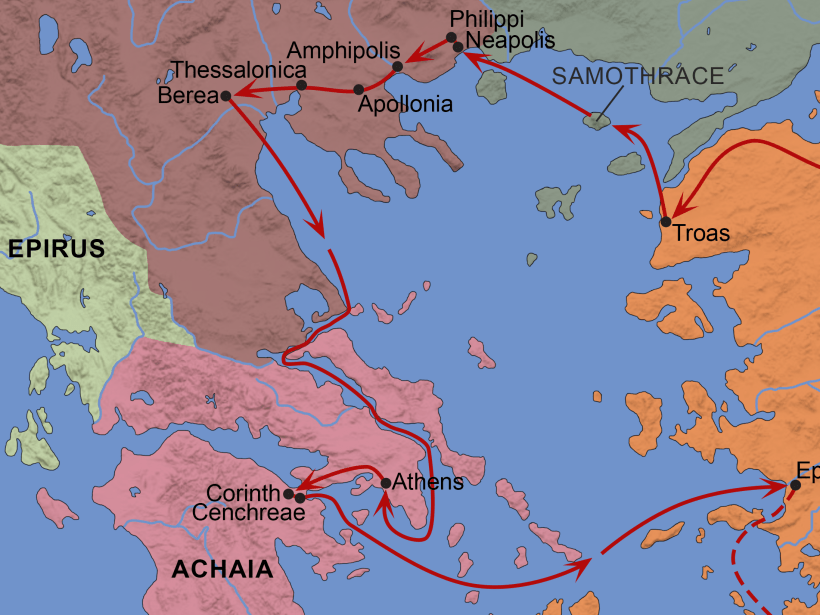
As we continue our journey with the apostle Paul, he has just left Berea (and Timothy and Silas) and traveled by sea south along the coast to Athens, accompanied by some of the Berean believers. Paul instructed his Berean companions to take word back to Timothy and Silas to join him as soon as possible in Athens and they left him there.
In preparation for reveiwing the events in Athens I suggest that you watch the following two videos about the Athens encounters:
- Con Campbell’s In Pursuit of Paul, episode 4, starting at the 11:40 mark.
- Dave Stott’s Bible Backroads, Acts episode 5 beginning at the 8:40 mark.
I also am grateful to Chris Forbes of the Oklahoma Baptist Association for the insightful article on this passage from which I’ve drawn some additional details. Luke picks up the story in Acts 17:16-34:
“Now while Paul was waiting for them at Athens, his spirit was provoked within him as he saw that the city was full of idols. So he reasoned in the synagogue with the Jews and the devout persons, and in the marketplace every day with those who happened to be there.“
Notice first of all that Paul’s “spirit was provoked within him”. I think this is in reference to Paul’s sensitivity to the leading of the Holy Spirit and also his sensitivity to the spiritual needs around him. It was the presence of the idols in the city that caused Paul such distress and recognition of the needs of the people. So, as was his usual procedure, he began attending the synagogue and reasoning with the Jews and other God-fearers there, and also sought out the Gentiles in the marketplace.
“Some of the Epicurean and Stoic philosophers also conversed with him. And some said, ‘What does this babbler wish to say?’ Others said, ‘He seems to be a preacher of foreign divinities’—because he was preaching Jesus and the resurrection. And they took him and brought him to the Areopagus, saying, ‘May we know what this new teaching is that you are presenting? For you bring some strange things to our ears. We wish to know therefore what these things mean.’ Now all the Athenians and the foreigners who lived there would spend their time in nothing except telling or hearing something new.“
Philosophy and religion were very popular in Greek culture, and especially in Athens. According to the Geneva Institute website, “Petronius once said that in Athens its easier to find a god than a man. Pausanias said that Athens had more images than all of Greece put together.” It was this that gave Paul the impetus to preach to the philosophical gathering at the Areopagus.
“So Paul, standing in the midst of the Areopagus, said: ‘Men of Athens, I perceive that in every way you are very religious. For as I passed along and observed the objects of your worship, I found also an altar with this inscription: ‘To the unknown god.’ What therefore you worship as unknown, this I proclaim to you.“
Paul focused on the “unknown god” as a way to garner their attention. In the article mentioned above, Chris Forbes points out that Paul utilizes a quote from a local poet (see below).
“The God who made the world and everything in it, being Lord of heaven and earth, does not live in temples made by man, nor is he served by human hands, as though he needed anything, since he himself gives to all mankind life and breath and everything. And he made from one man every nation of mankind to live on all the face of the earth, having determined allotted periods and the boundaries of their dwelling place, that they should seek God, and perhaps feel their way toward him and find him. Yet he is actually not far from each one of us, for “‘In him we live and move and have our being’; as even some of your own poets have said, “‘For we are indeed his offspring.’“
The quote that Paul referenced is from Epimenides, a philosopher and poet famous for an event in about 600 B.C. in Athens, as related in the book “Lives of the Eminent Philosophers” by Diogenes Laërtius.
“So he became famous throughout Greece, and was believed to be a special favourite of heaven. Hence, when the Athenians were attacked by pestilence, and the Pythian priestess bade them purify the city, they sent a ship commanded by Nicias, son of Niceratus, to Crete to ask the help of Epimenides. And he came in the 46th Olympiad, purified their city, and stopped the pestilence in the following way. He took sheep, some black and others white, and brought them to the Areopagus; and there he let them go whither they pleased, instructing those who followed them to mark the spot where each sheep lay down and offer a sacrifice to the local divinity. And thus, it is said, the plague was stayed. Hence even to this day altars may be found in different parts of Athens with no name inscribed upon them, which are memorials of this atonement.”
The Athenians held special reverence for Epimenides and the “unknown god” that saved them from the pestilence. Paul used this fact as an inroad to share the gospel with them.
“Being then God’s offspring, we ought not to think that the divine being is like gold or silver or stone, an image formed by the art and imagination of man. The times of ignorance God overlooked, but know he commands all people everywhere to repent, because he has fixed a day on which he will judge the world in righteousness by a man whom he has appointed; and of this he has given assurance to all by raising him from the dead.”
Notice that Paul uses the resurrection of Jesus as the defining evidence for his divinity.
“Now when they heard of the resurrection of the dead, some mocked. But others said, ‘We will hear you again about this.’ So Paul went out from their midst. But some men joined him and believed, among whom also were Dionysius the Areopagite and a woman named Damaris and others with them.“
Paul’s preaching led to the belief of two named people and some others in Athens. The sixteenth fresco painting from the Papal Basilica of Saint Paul Outside the Walls (and photographed by the Hermit’s Door) shows Paul preaching the gospel at the Areopagus.

In the next post on the Life of Paul we’ll follow him to Corinth and his reunion with Timothy and Silas and the report that he receives from them. Thanks for reading!
 The Watchmaker's Pulse