After leaving Philippi, Luke tells us, in Acts 17:1-15, that Paul, Silas, Timothy (and presumably) Luke went on to Thessalonica after leaving Philippi.
“Now when they had passed through Amphipolis and Apollonia, they came to Thessalonica, where there was a synagogue of the Jews.“
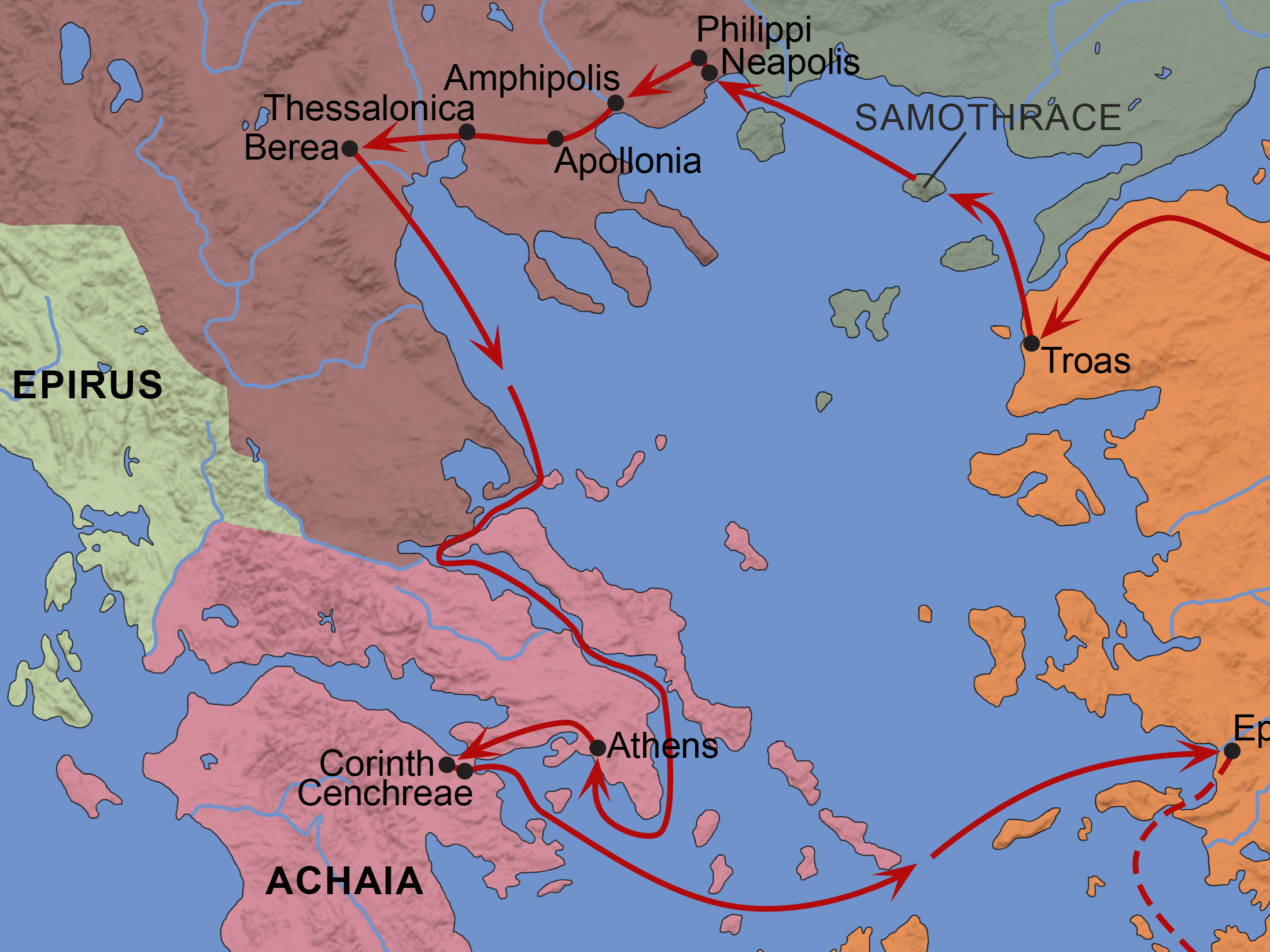
While there was apparently no synagogue in Philippi (which is why Paul went to the river seeking believers and a place of prayer), there was one in Thessalonica.
“And Paul went in, as was his custom, and on three Sabbath days he reasoned with them from the Scriptures, explaining and proving that it was necessary for the Christ to suffer and to rise from the dead, and saying, ‘This Jesus, whom I proclaim to you, is the Christ.’ And some of them were persuaded and joined Paul and Silas, as did a great many of the devout Greeks and not a few of the leading women.“
Paul used the scriptures to proclaim the characteristics of the Jewish Messiah (that he must suffer and rise from the dead) and to link those to Jesus. A number of Jews and Greeks were convinced and became believers. One of these was named Jason and apparently Paul and company made his home their base of operations (similar to Lydia’s in Philippi).
As in his description of the first missionary journey, Luke does not always provide a great amount of detail about timing. He said that Paul preached for 3 Sabbaths (at least 3 weeks), but it was probably much longer before the resistance against him became strong enough to cause him trouble. Part of the evidence for that is his statement to the Philippians a dozen or so years later (Philippians 4:16), “Even in Thessalonica you sent me help for my needs once and again.” “Once and again” implies several “care packages” that Paul received while in Thessalonica, which may indicate several months of time. Of course, these could have been “forwarded” on to him in one of the nearby later communities which we’ll read about shortly.
This would be a good time to watch the first episode of the Thessalonian series of Dave Stott’s Bible Backroads. It deals with the geography and archaeology of Thessalonica.
“But the Jews were jealous, and taking some wicked men of the rabble, they formed a mob, set the city in an uproar, and attacked the house of Jason, seeking to bring them out to the crowd. And when they could not find them, they dragged Jason and some of the brothers before the city authorities, shouting, ‘These men who have turned the world upside down have come here also, and Jason has received them, and they are all acting against the decrees of Caesar, saying that there is another king, Jesus.’ And the people and the city authorities were disturbed when they heard these things. And when they had taken money as security from Jason and the rest, they let them go.“
Jason and other believers were forced by the mob and the authorities to “post bail” in order to keep himself out of jail. One of the things that we’ll look at soon is Paul’s letters to the Thessalonians. In those letters Paul talks to them about standing strong in an environment of persecution. We get a glimpse of the animosity toward believers in this account of the attacks against Jason. They were falsely accused of fostering an insurrection against Caesar. These same accusations followed Paul and his companions on to the next place, just as it did in the province of Galatia (discussed in the Life of Paul 13 post).
Paul would later write in his first letter to them (4:11-12), “aspire to live quietly, and to mind your own affairs, and to work with your hands, as we instructed you, so that you may walk properly before outsiders and be dependent on no one.” This is the heart of Jesus’ “turn the other cheek” teaching, encouraging the believers not to react strongly against their persecutors, but rather to do their best to lead quiet non-confrontational lives. They were surrounded by lots of opposition, but they stand out as believers whose love for fellow believers stands out. Paul also wrote (4:9-10) “you yourselves have been taught by God to love one another, for that indeed is what you are doing to all the brothers throughout Macedonia.“
“The brothers immediately sent Paul and Silas away by night to Berea, and when they arrived they went into the Jewish synagogue. Now these Jews were more noble than those in Thessalonica; they received the word with all eagerness, examining the Scriptures daily to see if these things were so. Many of them therefore believed, with not a few Greek women of high standing as well as men.”
The fourth episode of Dave Stotts’ Bible Backroads Thessalonians series has some good background information on the Bereans starting at the 3 minute, 35 second point in the video.
“But when the Jews from Thessalonica learned that the word of God was proclaimed by Paul at Berea also, they came there too, agitating and stirring up the crowds. Then the brothers immediately sent Paul off on his way to the sea, but Silas and Timothy remained there. Those who conducted Paul brought him as far as Athens, and after receiving a command for Silas and Timothy to come to him as soon as possible, they departed.“
The Bereans were receptive to the teaching of Paul and were commended for searching out and confirming what he said from the scriptures. However, the trouble-makers from Thessalonica came to disrupt his ministry and he headed to Athens, leaving Silas and Timothy behind with instructions to join him later. I presume that Luke stayed with Paul, but he never explicitly states anything about his own actions.
A historical side note is worth mentioning here. It is about this time (c. 50-51 A.D.) that the Roman Emperor Claudius issues a decree expelling Jews from Rome. This sets up the coming meeting in Corinth between Paul and has soon to be new friends, Aquila and Priscilla (Acts 18:1-2).
We’ll pick up the Athens part of Paul’s story next time. Thanks for reading!
 The Watchmaker's Pulse