We are following Paul in his second missionary journey. He visited the Galatian churches and then traveled to Troas where he saw a vision directing him to cross the Aegean Sea to Macedonia. This post will focus on the events that happened at his first major destination – Philippi. Luke picks up the story in Acts 16:11-40.
“So, setting sail from Troas, we made a direct voyage to Samothrace, and the following day to Neapolis, and from there to Philippi, which is a leading city of the district of Macedonia and a Roman colony.“
The UNESCO World Heritage website has some great information and pictures of the archeology associated with the ancient Roman city of Philippi. There is a lot of original stonework preserved at the site. Here is a screenshot of a Google Earth image of the site.

This would be a good time to watch the Dave Stotts’ Bible Backroads episode about Ancient Philippi. It’s only about 8 minutes long!
Luke continues his narrative:
“We remained in this city some days. And on the Sabbath day we went outside the gate to the riverside, where we supposed there was a place of prayer, and we sat down and spoke to the women who had come together. One who heard us was a woman named Lydia, from the city of Thyatira, a seller of purple goods, who was a worshiper of God. The Lord opened her heart to pay attention to what was said by Paul. And after she was baptized, and her household as well, she urged us, saying, ‘If you have judged me to be faithful to the Lord, come to my house and stay.’ And she prevailed upon us.“
Paul went outside the city to the river anticipating finding a place of prayer there. His normal routine would have been to begin preaching in the local synagogue, so the assumption here is that there were not enough Jewish citizens in Philippi to warrant having a synagogue. Lydia is the first recorded convert to Christianity on the Macedonian/Grecian peninsula. It’s interesting to note that she was from Thyatira, which is back across the Aegean Sea in the region of Asia and Mysia that Paul had been forbidden by the Holy Spirit to preach in. Thyatira, though, is one of the seven churches that John’s book of Revelations is addressed to, so in the time from Paul’s journey (c. 50 A.D.) to the writing of Revelations (c. 90 A.D.) a church had been established in Thyatira, possibly by Paul himself during his third missionary journey.
But I digress. Lydia became a convert and invited Paul and his companions to accept the hospitality of her home. Then Luke segues into another story from Philippi.
“As we were going to the place of prayer, we were met by a slave girl who had a spirit of divination and brought her owners much gain by fortune-telling. She followed Paul and us, crying out, ‘These men are servants of the Most High God, who proclaim to you the way of salvation.’ And this she kept doing for many days. Paul, having become greatly annoyed, turned and said to the spirit, “I command you in the name of Jesus Christ to come out of her.” And it came out that very hour.“
The girl was technically speaking the truth when she identified Paul as a servant of God proclaiming salvation. But she was probably doing it in a mocking way that somehow was proving to be a distraction to Paul’s message (thus his annoyance with her). The thirteenth fresco painting from the Papal Basilica of Saint Paul Outside the Walls (and photographed by the Hermit’s Door) shows Paul (the haloed one in green) commanding the evil spirit to depart from the girl (apparently doing so as a serpent???). I don’t know who the other haloed individual is – perhaps Luke, Silas, or Timothy.

A consequence of the demon’s departure from the girl is that she lost her fortune-telling ability and thus her owner’s source of income.
“But when her owners saw that their hope of gain was gone, they seized Paul and Silas and dragged them into the marketplace before the rulers. And when they had brought them to the magistrates, they said, ‘These men are Jews, and they are disturbing our city. They advocate customs that are not lawful for us as Romans to accept or practice.’ The crowd joined in attacking them, and the magistrates tore the garments off them and gave orders to beat them with rods. And when they had inflicted many blows upon them, they threw them into prison, ordering the jailer to keep them safely. Having received this order, he put them into the inner prison and fastened their feet in the stocks.“
The fourteenth fresco painting from the Papal Basilica of Saint Paul Outside the Walls (and photographed by the Hermit’s Door) shows Paul (dressed now in blue rather than green) and Silas receiving the beating.
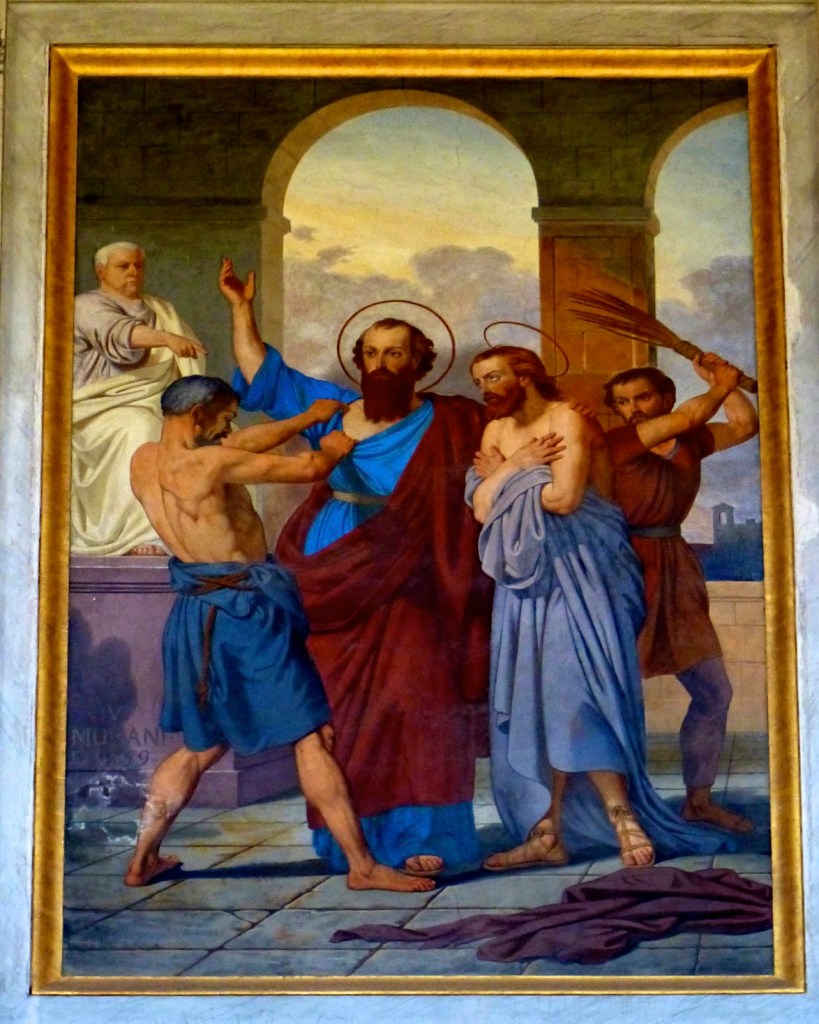
This is one of the three times that Paul identifies in his later second letter to the Corinthians (11:25) that he was beaten with rods.
“About midnight Paul and Silas were praying and singing hymns to God, and the prisoners were listening to them, and suddenly there was a great earthquake, so that the foundations of the prison were shaken. And immediately all the doors were opened, and everyone’s bonds were unfastened. When the jailer woke and saw that the prison doors were open, he drew his sword and was about to kill himself, supposing that the prisoners had escaped. But Paul cried with a loud voice, ‘Do not harm yourself, for we are all here.’ And the jailer called for lights and rushed in, and trembling with fear he fell down before Paul and Silas. Then he brought them out and said, ‘Sirs, what must I do to be saved?’ And they said, ‘Believe in the Lord Jesus, and you will be saved, you and your household.’ And they spoke the word of the Lord to him and to all who were in his house. And he took them the same hour of the night and washed their wounds; and he was baptized at once, he and all his family. Then he brought them up into his house and set food before them. And he rejoiced along with his entire household that he had believed in God.“
Notice that the jailer asked “what must I do to be saved?” He was likely thinking more about the potential immediate danger to his life from Roman authorities if his prisoners escaped. However, Paul seized the opportunity to answer the bigger question with regard to eternal salvation. The jailer and all his household believed the gospel!
The fifteenth fresco painting from the Papal Basilica of Saint Paul Outside the Walls (and photographed by the Hermit’s Door) illustrates Paul (back in his green outfit but missing his halo) consoling the jailer.

Take a break and watch another episode of Dave Stotts’ Bible Backroads which reviews the archaeology associated with the Bible events we just explored. This episode is only nine minutes long!
“But when it was day, the magistrates sent the police, saying, “Let those men go.” And the jailer reported these words to Paul, saying, “The magistrates have sent to let you go. Therefore come out now and go in peace.” But Paul said to them, “They have beaten us publicly, uncondemned, men who are Roman citizens, and have thrown us into prison; and do they now throw us out secretly? No! Let them come themselves and take us out.” The police reported these words to the magistrates, and they were afraid when they heard that they were Roman citizens. So they came and apologized to them. And they took them out and asked them to leave the city. So they went out of the prison and visited Lydia. And when they had seen the brothers, they encouraged them and departed.“
Thus ends Luke’s account of Paul’s adventures in Philippi. The church that was established there quickly figured out that they needed to show their appreciation to Paul and his companions through physical support of their ministry. It was about a dozen years after these events in Philippi that Paul wrote his letter to the Philippian church from his house arrest in Rome (we’ll be studying that later). In Philippians 4:14-16 he wrote, “Yet it was kind of you to share my trouble. And you Philippians yourselves know that in the beginning of the gospel, when I left Macedonia, no church entered into partnership with me in giving and receiving, except you only. Even in Thessalonica you sent me help for my needs once and again.”
The Philippian church, started with the conversion of Lydia and the jailer, would become a shining example of what it means to be a joyful congregation, but that’s for a later study. Thanks for reading. On to Thessalonica next time!
 The Watchmaker's Pulse