After the council meeting in Jerusalem that resulted in the letter from the Jerusalem church leaders to Gentile believers, Paul and Barnabas returned to Antioch in Syria accompanied by Judas and Silas. They all remained in Antioch for an indefinite period of time.
Then Luke tells us in Acts 15:36-41,
“And after some days Paul said to Barnabas, ‘Let us return and visit the brothers in every city where we proclaimed the word of the Lord, and see how they are.’ Now Barnabas wanted to take with them John called Mark. But Paul thought best not to take with them one who had withdrawn from them in Pamphylia and had not gone with them to the work. And there arose a sharp disagreement, so that they separated from each other. Barnabas took Mark with him and sailed away to Cyprus, but Paul chose Silas and departed, having been commended by the brothers to the grace of the Lord. And he went through Syria and Cilicia, strengthening the churches.“
You may recall us looking at Paul’s first missionary journey and the events surrounding John Mark’s departure. If not, it was in the Life of Paul 11 post. It was because of this previous experience that Paul and Barnabas had such a sharp disagreement over whether or not to allow Mark (Barnabas’ cousin) to accompany them again. They parted ways over this conflict and Barnabas and Mark went to Cyprus. This disagreement was unfortunate, but it may have served to further broaden the missionary work by splitting up their efforts. One of the writers for the “Drive Thru History” series (referenced in Life of Paul 15) wrote a short essay about what extra-biblical history and tradition tells us about Barnabas after he and Paul parted ways. Even though Barnabas’ work is not mentioned again in the New Testament, we know that this conflict was not a permanent rift because Paul references him and Mark in complementary ways several other (later) times in his letters. He uses Barnabas as an example in his first letter to the Corinthians (9:6) even though Barnabas was not with Paul when he visited Corinth. It’s possible that Barnabas went there later, or just that Paul had told them about Barnabas. Paul also gave instructions to the church of Colossae to welcome Barnabas if he visits them (Colossians 4:10).
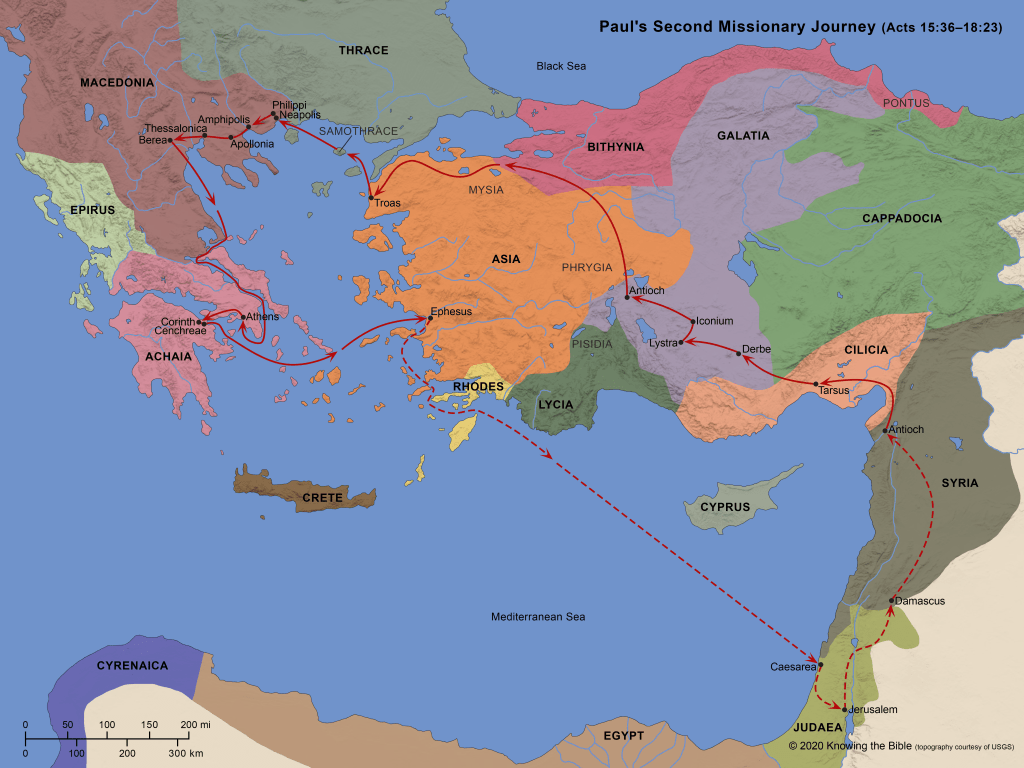
The following map illustrates the route of Paul’s second missionary journey.
I recommend Con Campbell’s In Pursuit of Paul episode about Paul’s 2nd journey.
Luke describes this journey in Acts 16 – 18. We’ll look at it bit by bit until we’re done. I don’t know yet how many blog posts that will be!
Acts 16:1-3
“Paul came also to Derbe and to Lystra. A disciple was there, named Timothy, the son of a Jewish woman who was a believer, but his father was a Greek. He was well spoken of by the brothers at Lystra and Iconium. Paul wanted Timothy to accompany him, and he took him and circumcised him because of the Jews who were in those places, for they all knew that his father was a Greek.“
This was now Paul’s third visit to Derbe and Lystra. On his first journey he preached there initially (and was nearly stoned to death in Lystra) and then returned to both of them near the completion of the journey to check on the progress of the new churches. Timothy is introduced to us on this visit to those cities. Paul may have met Timothy on the earlier trip, or at the very least met his mother and/or grandmother. In Paul’s final letter to Timothy he says (1:5), “I am reminded of your sincere faith, a faith that dwelt first in your grandmother Lois and your mother Eunice and now, I am sure, dwells in you as well.” Eunice was a Jewish Christian but was married to a Greek man who was presumably not a believer. Timothy had developed a good reputation within the church and Paul offered for him to join their journey. Notice that Paul encouraged him to be circumcised in order to be more well-received in Jewish circles. This is the opposite of what he argued in his letter to the Galatians because there he was arguing that circumcision was not to be performed as a supposed requirement for one’s salvation. This is consistent with Paul’s later teaching in 1 Corinthians 9:19-23:
“For though I am free from all, I have made myself a servant to all, that I might win more of them. To the Jews I became as a Jew, in order to win Jews. To those under the law I became as one under the law (though not being myself under the law) that I might win those under the law. To those outside the law I became as one outside the law (not being outside the law of God but under the law of Christ) that I might win those outside the law. To the weak I became weak, that I might win the weak. I have become all things to all people, that by all means I might save some. I do it all for the sake of the gospel, that I may share with them in its blessings.“
Luke continues in Acts 16:4-5:
“As they went on their way through the cities, they delivered to them for observance the decisions that had been reached by the apostles and elders who were in Jerusalem. So the churches were strengthened in the faith, and they increased in numbers daily.”
Here we find that Paul is hand-delivering the message found in the letter from the Jerusalem council. If you recall from the Life of Paul 15 post, the letter was not sent to the Galatian churches and it was my conjecture that this was because Paul had already written his Galatian letter.
We now encounter a couple of very interesting editorial comments from Luke in verses 6 and 7.
“And they went through the region of Phrygia and Galatia, having been forbidden by the Holy Spirit to speak the word in Asia. And when they had come up to Mysia, they attempted to go into Bithynia, but the Spirit of Jesus did not allow them. So, passing by Mysia, they went down to Troas.”
The Holy Spirit specifically forbade Paul from sharing the gospel in Asia and Bithynia (see the map above). We are not told why this occurred, nor how it occurred. The “how” could have been through direct revelation or through circumstantial prompts which forced their paths. The “why” is also not certain. It may be that God intentionally withheld Paul’s message from those people because of a history of antagonism or their part. Or, perhaps he had in mind for other people to do the missionary work there. Or perhaps there was an urgent need to send Paul on into Greece. Hence the next verses…
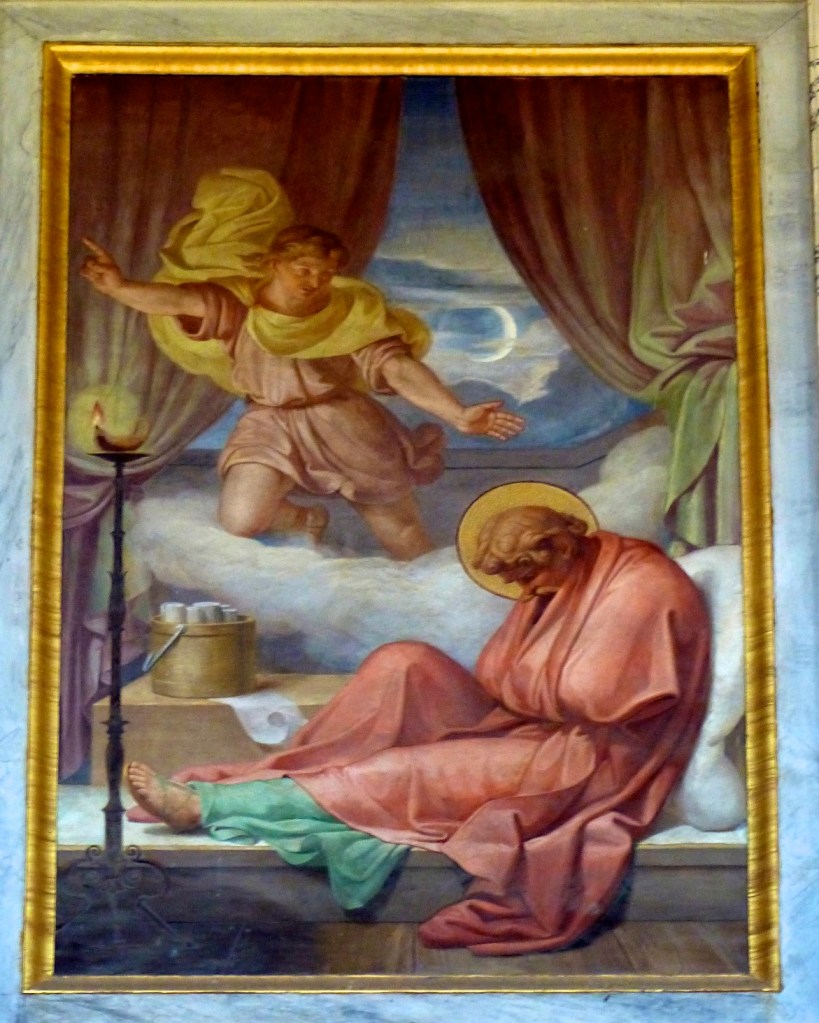
“And a vision appeared to Paul in the night: a man of Macedonia was standing there, urging him and saying, ‘Come over to Macedonia and help us.’ And when Paul had seen the vision, immediately we sought to go on into Macedonia, concluding that God had called us to preach the gospel to them.“
The twelth fresco painting from the Papal Basilica of Saint Paul Outside the Walls (and photographed by the Hermit’s Door) depicts Paul (again with that halo) sleeping as the angelic messenger appears to direct him to Macdeonia.
You’ll also notice in these verses that Luke first uses the term “we” in his description of the travelers. It is thought that Luke met Paul in Troas and decided to join the troupe. Now the known travelers are Paul, Silas, Timothy, and Luke.
Luke finishes this passage with verses 11 and 12.
“So, setting sail from Troas, we made a direct voyage to Samothrace, and the following day to Neapolis, and from there to Philippi, which is a leading city of the district of Macedonia and a Roman colony.”
I’m going to stop here, as it seems a logical place to take a break. Next time we’ll take a look at the events that happened in Philippi. Thanks for reading!
 The Watchmaker's Pulse