Pioneer Village at Shingle Creek (2491 Babb Rd. in Kissimmee, FL) does not represent an actual village but rather is intended to illustrate life in central Florida around 1900. That being said, though, many of the buildings (both original and reconstructed) are buildings which served their time in the pioneer community of Narcoossee, which is located on the eastern shore of East Lake Tohopekaliga.
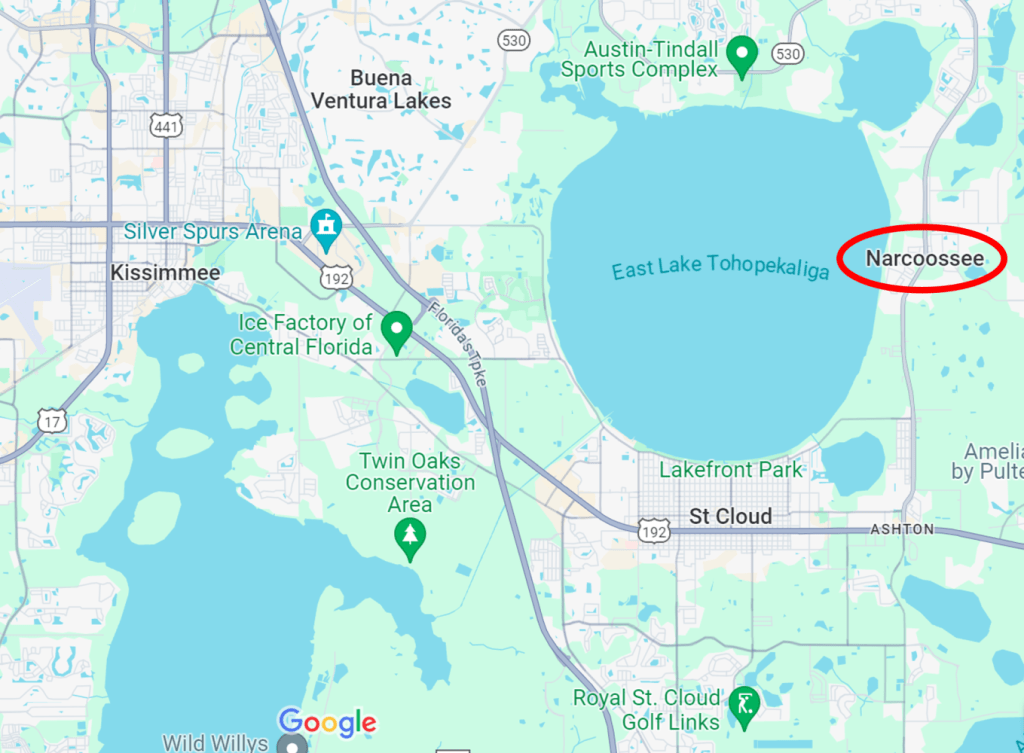
Narcoossee was established in 1884 by real estate developers Nelson Fell and Walter Davidson. They surveyed and sectioned off 2,000 acres of newly purchased frontier land and advertised it in England as lots for retirement and agricultural ventures. Many of the early settlers of Narcoosee came from England.
One of the early residents whose story is told at Pioneer Village were William and Jane Cadman. William was a retired British Lieutenant Colonel. Jane, his second wife, was reportedly a lady-in-waiting to Queen Victoria. They arrived in Narcoossee in 1888 and immediately fell in love with a model home which had been built by Fell & Davidson to showcase their property venture. The Cadman’s struck a deal to purchase “The Bungalow” (as Jane liked to call it) and the already existing orange orchard around it. Their daughter, Margery, came from England with them, as well as their domestic servant Sarah Evans. Their three older boys finished school in England before joining the family in Narcossee a few years later.

Pioneer Village has their original 1884 house with a parlor, dining room, and two bedrooms furnished with period furnishings, much of which originally belonged to the Cadman’s. There is a connected, but separate, kitchen; a bunkhouse that the boys slept in, and a packing house used for processing and preparing their orange crops for shipping.

Right next to the Cadman house is a recreation of the Narcoossee church that they led the fund-raising effort for. The Episcopal church of St. Peter was consecrated in 1898 and used for several decades. However, Narcoossee had an economic downturn that caused the population to dwindle and the church to be abandoned in 1920. In 1930 the St. Luke’s church in St. Cloud purchased the building, moving it board by board and added it to their church, calling it the Church of St. Luke and St. Peter.

Other Narcoossee reproductions are the schoolhouse, the general store, and the train depot. One more original home is the Tyson house, which was built in 1920. The one-room house represents a more meager, agricultural based existence. It was built by the son of one of the original residents of Narcoossee.
In my final post about Pioneer Village, I’ll talk about the rest of the structures which represent other dwellings outside of the Narcoossee region.
 The Watchmaker's Pulse
2 thoughts on “Pioneer Village – Part 2”