The Osceola County Welcome Center and History Museum (where I work) tells the story of the cultural and natural history of the county. A few weeks ago I posted some information about the natural history story that we tell. Today, I’m going to share a little about the local human history as portrayed in the museum.
The first humans in Florida arrived in connection with the other first peoples – utilizing the ice connection between Asia and North America during the last Ice Age. The oldest artifact we have in our museum may date as far back as 11,000 B.C. It’s a spear point.

The first Europeans to arrive were the Spanish explorers and they ultimately founded the oldest European settlement in North America (in 1565) – St. Augustine.
Florida became a U.S. Territory in 1821 and a state in 1845. Osceola County is in central Florida (just south of Orlando and Orange County). It was established in 1887 from the southern part of Orange County and the western part of Brevard County. When the county was established, there were only about 815 residents in a county that was over 1500 square miles in size. Kissimmee, which began as a trading post on the north shore of Lake Tohopekaliga, was named the county seat of government.
Osceola County was given its name as tribute to the Seminole leader Osceola, pictured here in a drawing from McKenney and Hall’s 1842 book “History of the Indian Tribes of North America.”

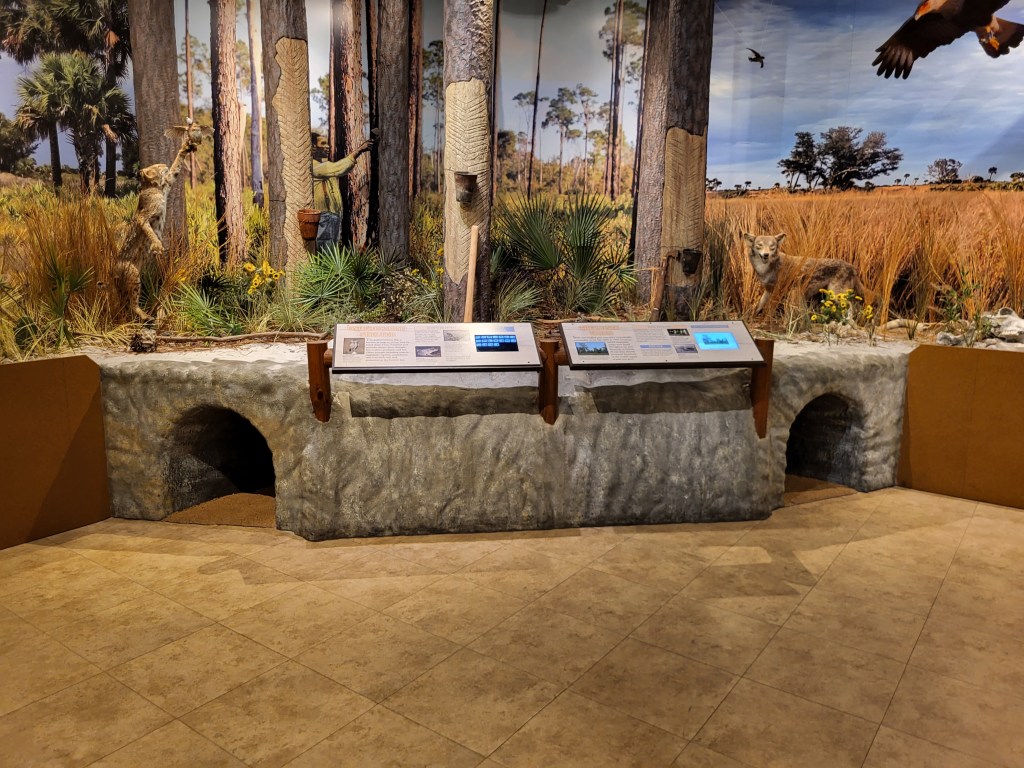
Central Florida attracted industrialists with its vast pine forests and cypress swamps. At one point, Florida was providing 20% of the world’s turpentine supply from the pine trees (which were killed in the process, unfortunately).
When the Spanish left Florida, they also left behind cattle which became wild and later known as Cracker Cattle. These formed the initial basis for the cattle ranching culture that developed in Florida. When Osceola County was first formed cattle ranching was “open-range” ranching, which means that cattle were branded by their owners and then released back into the swamps. Then, each year cow men (not called cowboys in Florida) would ride out and spend several weeks searching for and rounding up the cattle that bore their brand. They would drive them to be loaded onto riverboats or trains in Kissimmee to be shipped to market.
Speaking of riverboats and trains, the first train tracks reached Kissimmee from the north in 1882. In that same year Hamilton Disston, and entrepreneur from Philadelphia, opened a shipyard in Kissimmee and set up his local headquarters. He had just made a deal with the state of Florida to purchase 4 million acres of swampland for $0.25/acre. His plan was to dredge canals between all the lakes in the region and drain the swamps to convert it into farmland. He succeeded in draining about 2 million of those acres and sold the land at a handy profit.
This brought a lot of agriculturalists (e.g. farmers) to Florida. Oranges had been introduced in the wild by the Spanish, and orange groves began to be planted throughout the region. Sugar cane, pineapples, and fruits and vegetables of all types thrived in the rich former swamplands.
Our museum also tells the stories of several communities besides Kissimmee. St. Cloud, a little further east, was established as a Civil War Veterans community from property once occupied by a Disston Sugar Plantation and Mill. Narcoossee, on the east shore of East Lake Tohopekaliga, was a community of English settlers who were attracted to Florida from ads placed in the London newspaper by real estate developers Fell & Davidson.
As Kissimmee grew, it became a popular tourist destination (this is well before the current theme park developments). Central Florida was attractive to people from the northern states who sought warmer climates to live or vacation in. Florida was a popular “ecotourism” site, attracting hunters, fishermen and wildlife enthusiasts who wanted to spend time exploring the wilds of the land.

The rest is history, I guess you could say. The latter part of the twentieth century has brought explosive growth to the region and central Florida, including Osceola County, is one of the fastest growing places in the nation.

 The Watchmaker's Pulse
One thought on “History Museum”