In the last Life of Paul post, we saw Ananias being told to find Paul in Damascus, heal his eyes, and baptize him. The story picks up from there. The information we have from Scripture is fairly short, but it calls for some lengthy speculation about what all happened to Paul next.
Here are the relevant Scripture passages first. Acts 9:19-22 tells us:
“For some days he was with the disciples at Damascus. And immediately he proclaimed Jesus in the synagogues, saying, ‘He is the Son of God.’ And all who heard him were amazed and said, ‘Is not this the man who made havoc in Jerusalem of those who called upon this name? And has he not come here for this purpose, to bring them bound before the chief priests?’ But Saul increased all the more in strength, and confounded the Jews who lived in Damascus by proving that Jesus was the Christ.“
There are several things which should be considered from this passage.
- Paul initially spent some time with other Christians (probably including Ananias) in Damascus. He probably shared his testimony of meeting Jesus on the road, and he also would have heard their own stories and testimonies. In other words, they would have discipled Paul in his newfound faith.
- However, even though he was a new Christian, Paul already had extensive biblical knowledge and familiarity with Jewish faith. Therefore, he quickly begins preaching in the synagogues and his message is a simple one – that Jesus is the Son of God and is God’s Messiah.
- The hearers who were aware of Paul’s persecution of Christians are mentioned in the context of his synagogue preaching. I envision these Jews thinking, “this man was against Jesus, but now he’s for him” and this piqued their curiosity.
- Over time Paul increased in strength – both physical strength and probably the strength of his arguments.
Luke then goes on to tell us (Acts 9:23-25):
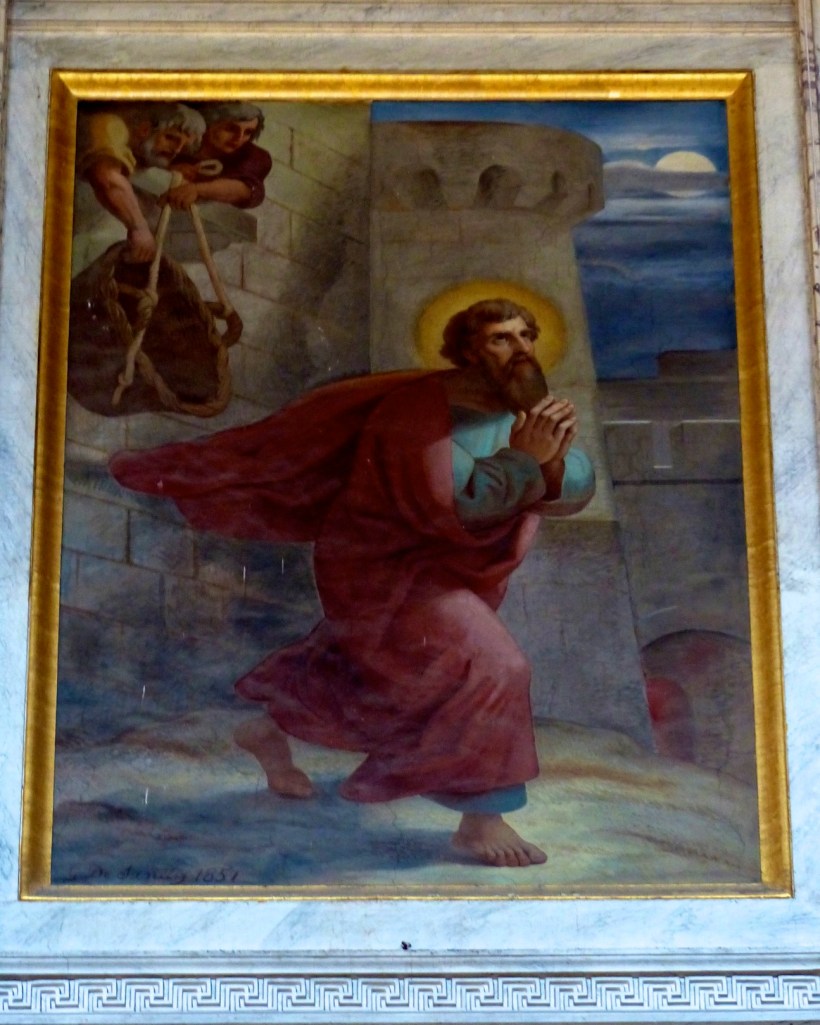
“When many days had passed, the Jews plotted to kill him, but their plot became known to Saul. They were watching the gates day and night in order to kill him, but his disciples took him by night and let him down through an opening in the wall, lowering him in a basket.“
Luke indicates that many days had passed, but these “many days” were probably three years (explained below)! Luke, acting as a historian here, like any historian, is telling us the story that he (and the Holy Spirit) wishes. He can’t put every detail in but selects the ones most pertinent to the history he is conveying. This passage adds the following details which should be considered:
- Paul had developed a set of disciples, also indicating that there was a substantial amount of time represented here.
- The Jews who were seeking to harm Paul were watching the “gates.” This seems to point to the idea that Paul was coming and going relative to Damascus, so he must have been spending some time elsewhere as well.
We learn more, though, from Paul’s own letter to the churches in Galatia. In Galatians 1:11-18a, he says:
“For I would have you know, brothers, that the gospel that was preached by me is not man’s gospel. For I did not receive it from any man, nor was I taught it, but I received it through a revelation of Jesus Christ. For you have heard of my former life in Judaism, how I persecuted the church of God violently and tried to destroy it. And I was advancing in Judaism beyond many of my own age among my people, so extremely zealous was I for the traditions of my fathers. But when he who had set me apart before I was born, and who called me by his grace, was pleased to reveal his Son to me, in order that I might preach him among the Gentiles, I did not immediately consult with anyone; nor did I go up to Jerusalem to those who were apostles before me, but I went away into Arabia, and returned again to Damascus. Then after three years I went up to Jerusalem…“
Some things to consider from this passage include:
- Paul indicates that the gospel he preaches is based not on what others have said but on what was directly revealed to him by Jesus. Initially, this was his encounter with Jesus on the road to Damascus. Now we will learn later that by the time he wrote the letter to the Galatians, he had other visions from Jesus as well, but his foundational encounter with the risen Christ was on that Damascus road.
- Paul said that he initially acted based on this revelation alone. However, as I pointed out above, he did consult with other believers in Damascus, and the apostles in Jerusalem at a later time.
- Paul did not remain in Damascus but spent three years in Arabia. I’ll discuss more about this later.
The final Scripture passage relevant to this post is found in 2 Corinthians 11:32-33. Paul says “At Damascus, the governor under King Aretas was guarding the city of Damascus in order to seize me, but I was let down in a basket through a window in the wall and escaped his hands.” This indicates that it wasn’t only the Jews who were seeking to capture or kill Paul. Paul somehow caught the attention of King Aretas and the governor located in Damascus was apparently trying to capture Paul on behalf of Aretas.
Now that I’ve listed the pertinent Scriptures, I’ll propose a narrative of what Paul did during these three years. As for dates – going with the largely accepted date for Jesus’ crucifixion in 33 A.D., Stephen’s martyrdom in about 35 A.D., and Paul’s trip to Damascus about 36 A.D., that would make the three years in Arabia about 36 to 39 A.D. It can’t be much later than this because of the identification of King Aretas.
But first, Paul after meeting with the local believers in Damascus and garnering their trust, Paul began to preach in the synagogue(s). He already had credentials as a Pharisee and as a disciple of Gamaliel. He also already had extensive knowledge of the Hebrew scriptures. Paul probably already had a good grasp of the messianic prophecies in the scriptures – he just had to spend some time wrapping his head around how those scriptures were fulfilled in the life of Jesus. This is where I presume there were some lively and interesting discussions among Paul’s initial “discipleship group”.
The fifth fresco painting from the Papal Basilica of Saint Paul Outside the Walls (and photographed by the Hermit’s Door) depicts Paul preaching in a synagogue in Damascus.
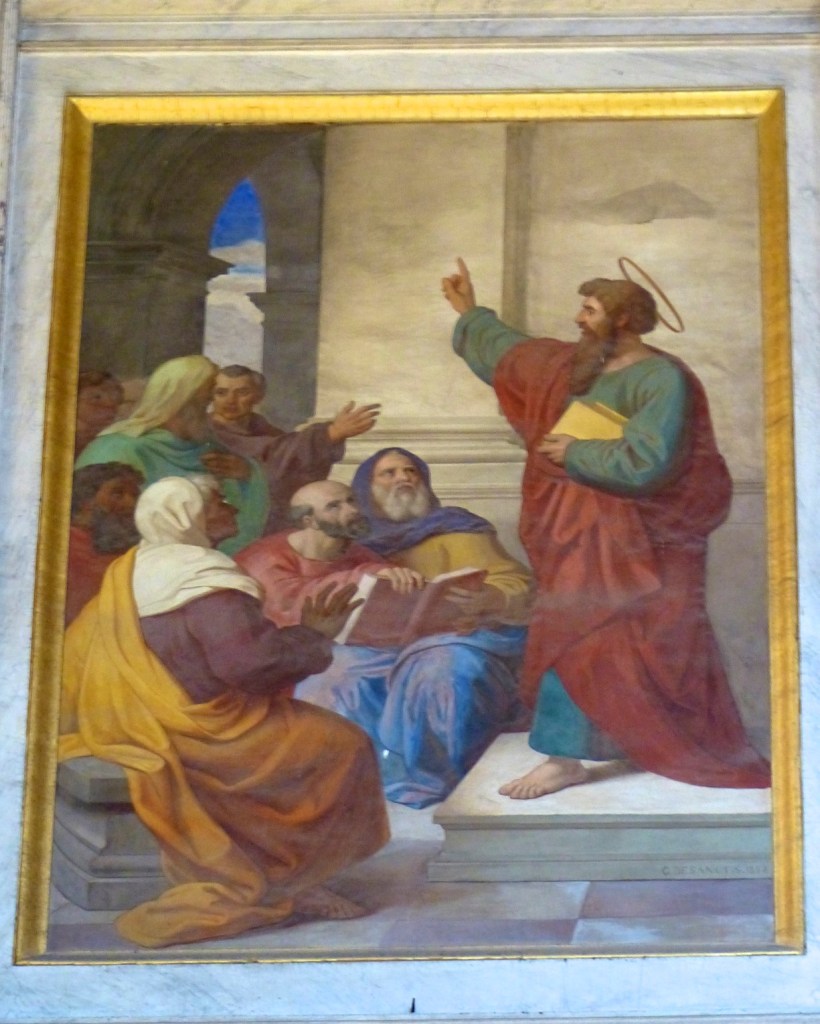
Now all we can do is speculate on what all happened during Paul’s three years in Arabia, so keep that in mind as you continue reading. Paul may have left Damascus because he started meeting resistance from the Jews. But this resistance may have only been part of the story. Paul had heard from Jesus that he was to be a missionary to the Gentiles, and Damascus was connected to a lot of Gentile territory.
In the first century A.D., the Nabataean kingdom was at its height of influence and power. Nothing to match Rome, of course, but nevertheless it had established significant dominance in the region. The following map (from an article called The Nabataean Age) shows the extent of the Nabataean kingdom that would reflect the region Paul referred to as “Arabia.” You’ll notice that Damascus lies at the northern end of this territory.
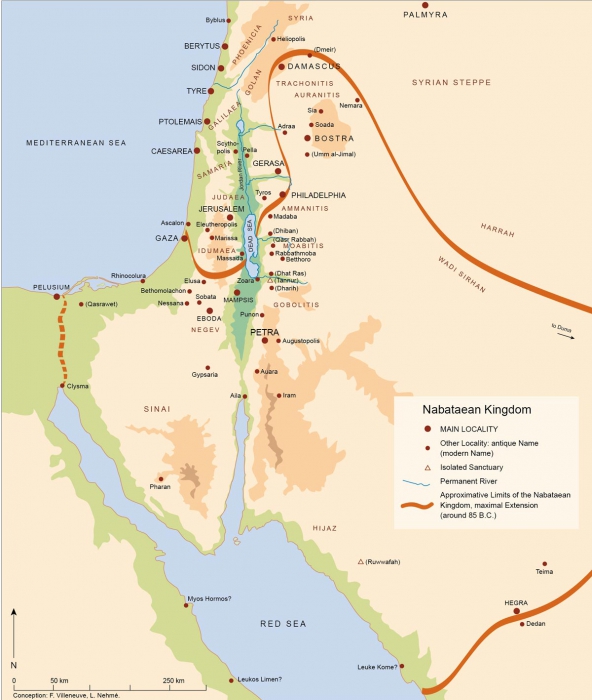
King Aretas (mentioned above by Paul in the 2 Corinthians passage) was king of the Nabataeans and, interestingly, the father of the woman that Herod Antipas divorced in order to marry the divorced wife of his brother. This was the situation that John the Baptist spoke against and which ultimately led to his death (see Mark 6). King Aretas established Petra as the capitol of his kingdom and the great “treasury” there (featured in Indiana Jones and the Holy Grail) was constructed by Aretas to be used as his tomb. The picture below is from Wikipedia.
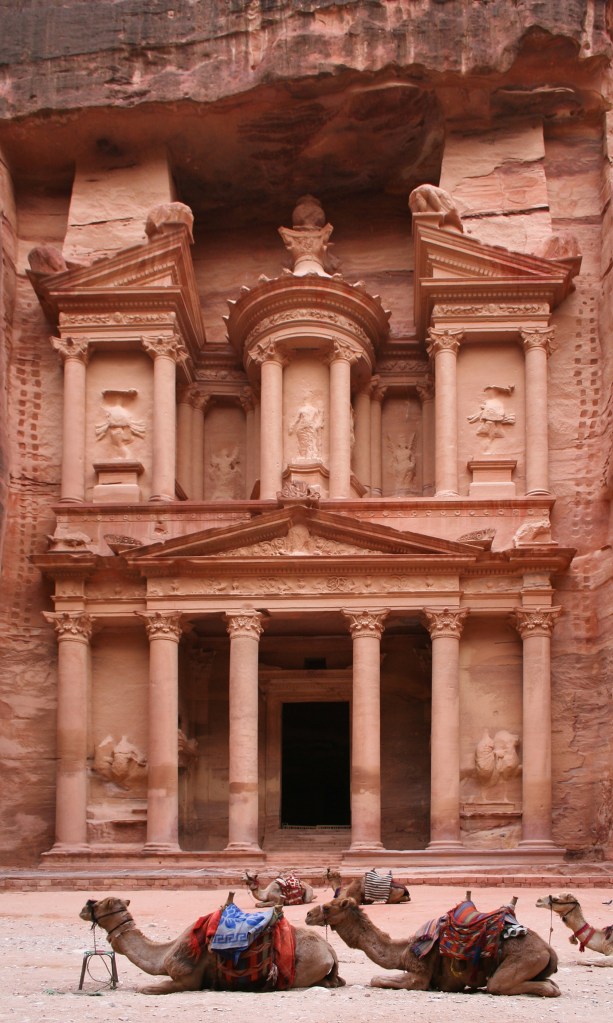
While it is merely speculation, there is a good chance that Paul visited Petra or even lived there for a time during his three year stint in Arabia. He had tent-making skills and could have sustained a living marketing these skills to people traveling the trade routes throughout Arabia.
The people inhabiting this region were, at least in part, probably descendants of Ishmael, Abraham’s first-born son. God had established his covenant through Abraham’s son Isaac, but had also promised to make Ishmael the father of many nations as well. These foundational stories, and the ties to God’s covenantal promise of the Messiah could have been useful tools for Paul as he spoke of the Gospel in Petra. It is possible that Paul made some disciples, but possibly also so enemies while in Arabia. He may have stirred the ire of King Aretas somehow through his message. At any rate, this time could have served as valuable “on-the-job training” for Paul’s future missionary efforts.
A good exploration of this topic can be seen in the Our Daily Bread video series In Pursuit of Paul. I referenced it in the last Life of Paul post. The host, Constantine Campbell, visits Petra and talks about the possibility of Paul’s visit there. The YouTube link for this episode is shown below.
After his three years doing whatever he was doing in Arabia, Paul returned to Damascus for a final time and learned of a plot to kill him or capture him for Aretas. His disciples lowered him through a window in a basket to help him escape. The sixth fresco painting from the Papal Basilica of Saint Paul Outside the Walls depicts this event.
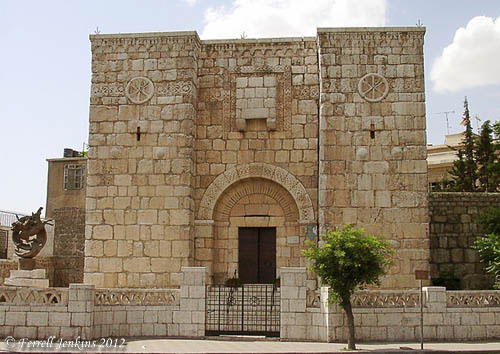
There is an traditional site in Damascus that is associated with Paul’s window escape. Another blogger, Ferrell Jenkins, has the following photograph of it on his blog site.
One takeaway that I have from this discussion is the encouragement we should feel in recognizing that Paul (just like Jesus’ disciples) had his own learning curve and varied experiences with sharing his faith with others. God chose him and used him, but also allowed him time to grow and learn.
Next time we’ll follow Paul back to Jerusalem.
 The Watchmaker's Pulse
One thought on “Life of Paul 8”