I use my calendar(s) a lot. I have a paper one on the wall, a paper one on the wall at work, a personal e-calendar on my phone (which is synced to my computer), and a work e-calendar that I maintain for people at my workplace. They can be a nuisance to have to keep updated, but they are also good references to keep track of future events, daily schedules, and even as records of past events. I use them almost as a database to help me record important information that I want to be able to remember.
The visions that Daniel records in his book of the Bible are all glimpses that God gave him of the calendar of human history. Last time (in Daniel 9), we saw Daniel reading Jeremiah’s prophecy about how long Israel would be in exile from Jerusalem (70 years) in Babylon. Recognizing that the promised time was imminent, Daniel pleaded with God for forgiveness for the nation and for mercy in fulfillment of His promises. Now we turn to the second part of the chapter (verses 20-27) in which Daniel receives another one of these visions concerning the future.
“While I was speaking and praying, confessing my sin and the sin of my people Israel, and presenting my plea before the LORD my God for the holy hill of my God, while I was speaking in prayer, the man Gabriel, whom I had seen in the vision at the first, came to me in swift flight at the time of the evening sacrifice.”
Here Daniel references the vision that he recorded in Chapter 8 in which Gabriel was told to explain the vision of the ram and the goat to Daniel (discussed in my study post on December 2). Apparently Gabriel has a job as some sort of chief messenger to deliver oracles from God directly to certain humans. As a reminder, he was the one who told Mary and Joseph about the coming birth of Jesus.
“He made me understand, speaking with me and saying, ‘O Daniel, I have now come out to give you insight and understanding. At the beginning of your pleas for mercy a word went out, and I have come to tell it to you, for you are greatly loved. Therefore consider the word and understand the vision.’“
Notice that Gabriel received his orders “at the beginning” of Daniel’s pleas. We’ll see something similar in another chapter later. God wanted Daniel to understand that he is “greatly loved.” Now on to the details of the vision.
“‘Seventy weeks are decreed about your people and your holy city, to finish the transgression, to put an end to sin, and to atone for iniquity, to bring in everlasting righteousness, to seal both vision and prophet, and to anoint a most holy place.’“
The reference to seventy weeks may or may not have been clear to Daniel, but just as looking at a calendar can help to understand the big picture of related events, so looking back at this prophecy from a future perspective helps us to understand it more fully. These “weeks” are periods of seven years each – e.g. a week of years. so seventy weeks represents 490 years. Gabriel elaborates on these numbers in the next verses, but first notice what has to take place during the 490 years:
- to finish the transgression
- to put an end to sin
- and to atone for iniquity
The first three items are related, and the last three items are related. The first item, to “finish the transgression,” means that God is allowing the events leading to his actions to run to completion. This is typical of how God works. He doesn’t rush things. For example, in Genesis 15:13-16 God told Abraham that his descendants would be captive in a foreign country (Egypt) for 400 years before they would be allowed to come back to the promised land because “the iniquity of the Amorites is not yet complete.” God kept Israel in Egypt because he was going to use them to exact judgment on the people of Canaan, but he allowed so much time to pass for their sin to reach its climax.
The second event of the 490 years in Daniel’s vision was to “put an end to sin.” Now we know that sin still exists in the world, so what could this prophecy mean that sin would be ended? Hmmmm. The third event is related – “to atone for iniquity.” Sin would be ended and fully atoned (paid) for.
The next three items are
- to bring in everlasting righteousness
- to seal both vision and prophet
- and to anoint a most holy place.
I’ll come back to these. Let’s continue with Gabriel’s explanation.
“‘Know therefore and understand that from the going out of the word to restore and build Jerusalem to the coming of an anointed one, a prince, there shall be seven weeks. Then for sixty-two weeks it shall be built again with squares and moat, but in a troubled time. And after the sixty-two weeks, an anointed one shall be cut off and shall have nothing.’”
First, Gabriel speaks here of 69 weeks, not 70. The last week is separated (in the next verses) in his explanation from the others. Second, he talks about an anointed one coming after the completion of the 69 weeks, and this anointed one would be “cut off”.
The 69 weeks begins with “the word to restore and build Jerusalem” and ends with the cutting off of the anointed one. This is 483 years. Nehemiah 2 describes Nehemiah requesting King Artaxerxes of Persia to let him lead a delegation to Jerusalem to rebuild it, which Artaxerxes allows him to do. This was in 445 B.C. It was 478 years after that that Jesus was crucified (“cut off”).
The ESV Bible Online Global Study Bible has a diagram (shown below) which illustrates various ways that people tend to interpret these 70 weeks. I personally lean toward the Dispensational View largely because that’s the way I’ve learned it over the years, but also because it seems to me to make the most sense to me as I read the scriptures.
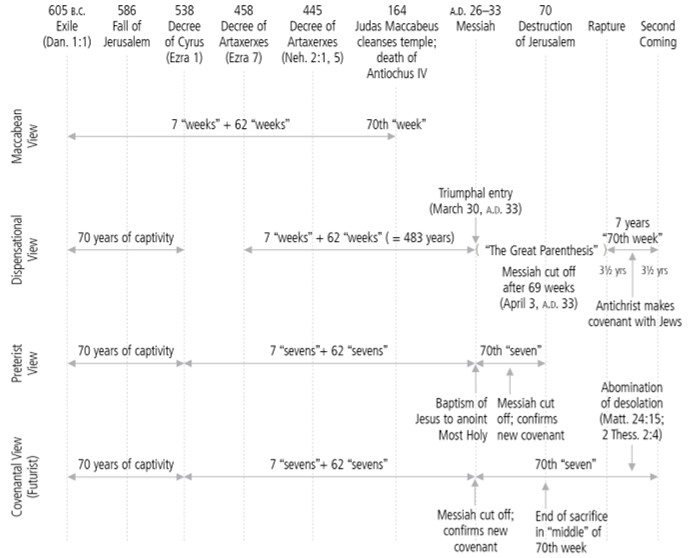
The six items bulleted from the verse above fit the work of the Messiah (Jesus). He accomplished the first three with his death on the cross. The last three bullets (to bring in everlasting righteousness, to seal both vision and prophet, and to anoint a most holy place) are events which are promised but have not come to full fulfillment yet. His life and death accomplished the first three (finish the transgression, to put an end to sin, and to atone for iniquity) and started the process for the second three. Everlasting righteousness is made available to us through faith in Jesus and evidenced by his resurrection from the dead. But it won’t be fully realized until after the Great White Throne judgment that we read about in other Scriptures (and which I’ll mention later in the Daniel study).
To “seal both vision and prophet” implies that all prophecy will be fulfilled, which hasn’t happened yet. Also the “most holy place” which will be anointed may very well be the one in heaven which is copied and represented by the most holy place of the biblical tabernacle and temple. This anointing, or dedication, may very well coincide with the great worship service described in Revelation as part of the ushering in of God’s final judgment on the world.
Let’s continue looking at Gabriel’s explanation of the vision:
“‘And the people of the prince who is to come shall destroy the city and the sanctuary. Its end shall come with a flood, and to the end there shall be war. Desolations are decreed.’”
This is a direct reference to the destruction of Jerusalem and the Temple. I (and many interpreters) believe that this is the destruction foretold by Jesus himself which occurred in 70 A.D. when the Romans destroyed the Temple. By this interpretation, this verse stretches far beyond that destruction into the future, with the phrase “to the end there shall be war.” The Jews will be made desolate and warred upon for many years afterward. Note that to this point only 69 of the 70 weeks identified in this vision have taken place. The final week is still to come.
“‘And he shall make a strong covenant with many for one week, and for half of the week he shall put an end to sacrifice and offering. And on the wing of abominations shall come one who makes desolate, until the decreed end is poured out on the desolator.’”
This verse likely projects into the future where a future leader (we identify him as the “antichrist” will make a covenant with Israel and allow sacrifices, which are not currently happening. The sacrificial system ended when the curtain separating the inner Holy of Holies place from the outer chamber of the temple was torn by God when Jesus died (e.g. Matthew 27:51). This antichrist will inflict more abominations on the new temple and Israel, and then will come God’s final judgment. We get more details on this in other scriptures which I’ll discuss in a later post.
Thanks for reading, and I hope you have a Merry Christmas!
 The Watchmaker's Pulse
One thought on “Daniel 9 (Part 2) – A Glimpse at God’s Calendar”